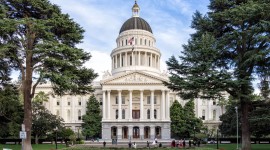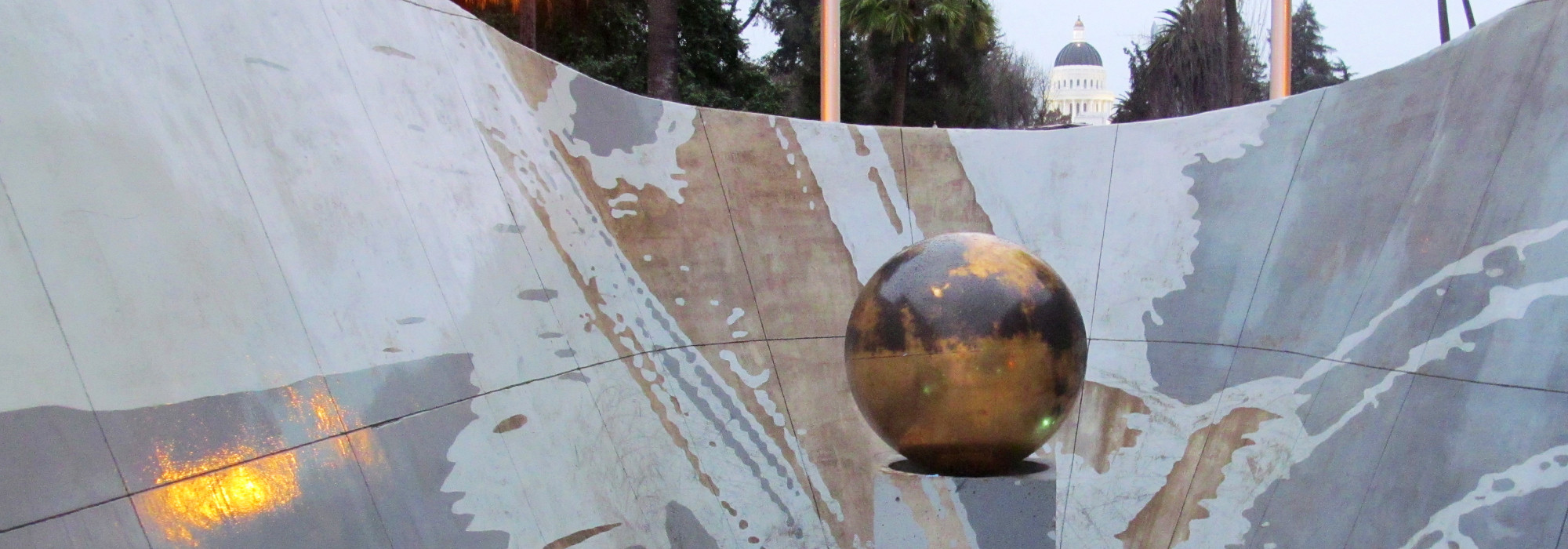
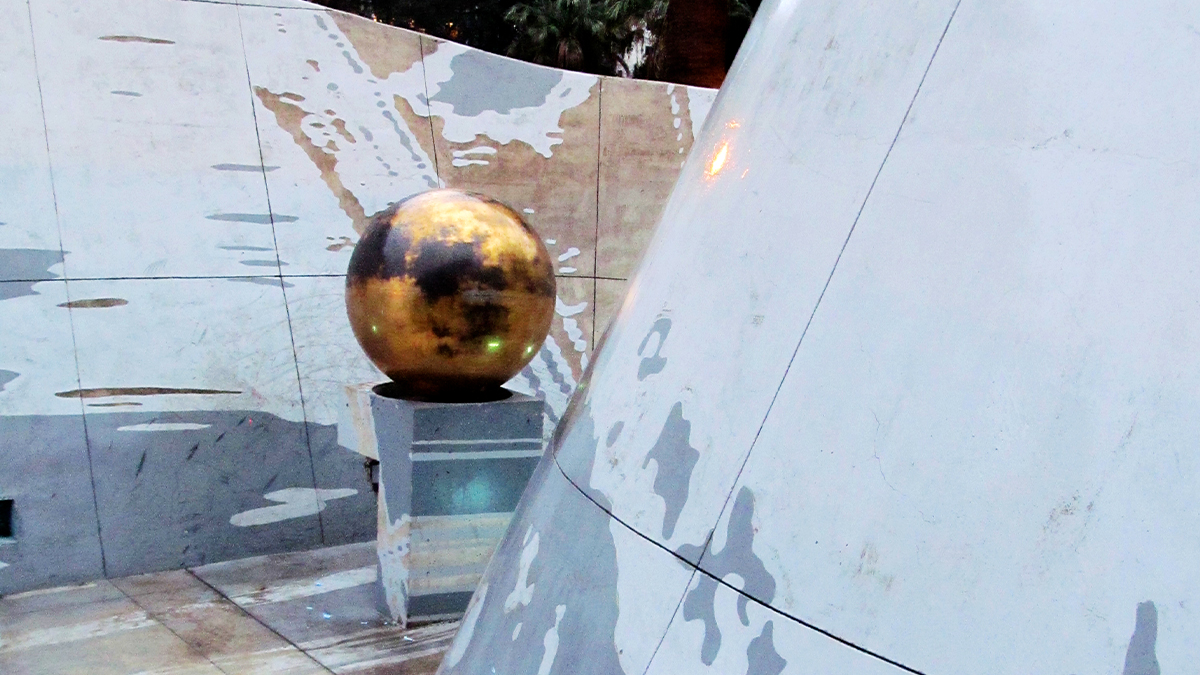
Framed by Capitol Avenue between 15th and 17th Streets, this approximately one-acre park was designed by artists Lita Albuquerque and Mitchell De Jarnett in 2004. Intended to interpret the state’s history and culture, Golden State is the largest state-funded public art installation in California history. Oriented on axis with the Capitol Building, the park is visually and physically connected to California State Capitol Park to the immediate west. The park serves as the eastern anchor of the city’s spine that originates at the Sacramento River, connecting the Beaux-Arts Capitol Mall, the Capitol Building, and California State Capitol Park. Golden State is framed by government buildings designed concurrently by architects Johnson Fain and Gruen Associates.
Described by Albuquerque as a “walking exhibition through the history of gold, science and astrophysics,” Golden State includes three distinct segment bisected by 16th Street. The U-shaped easternmost portion comprises a four-tier granite amphitheater and two 25-foot-tall vertical water features. The middle section, located west of 16th Street, includes 55 steel sculptural pedestals set on a rolling lawn traversed by a paved, curvilinear path. Each pedestal is topped with an illuminated glass disc etched with historical vignettes and text that honors the state’s pioneers, artists, and innovators. The pedestals are arranged to replicate the stars as they appeared the night of September 9, 1850—the date California became a state. Immediately west is a sloping, canyon-like passageway that frames borrowed views of the Capitol. Golden State is anchored to the west by flagpoles and symmetrical plantings of palm trees that echo the palm tree allées framing the park opposite 15th Street.