Landscape Information
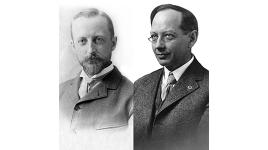
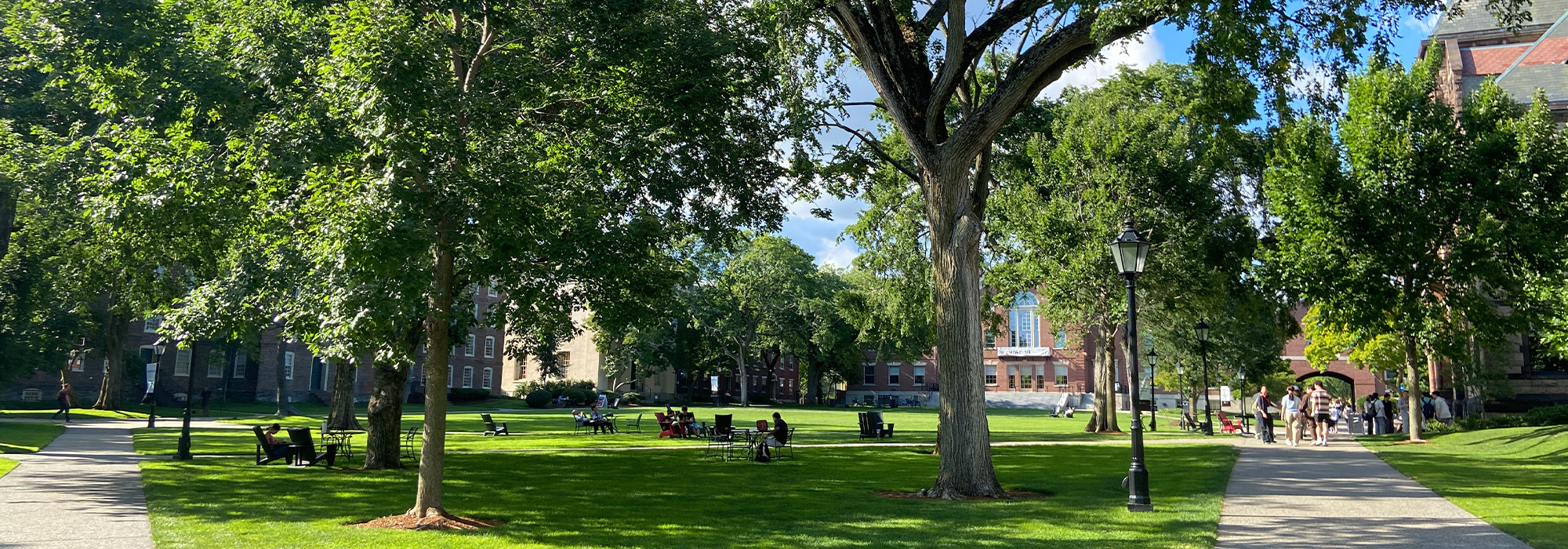
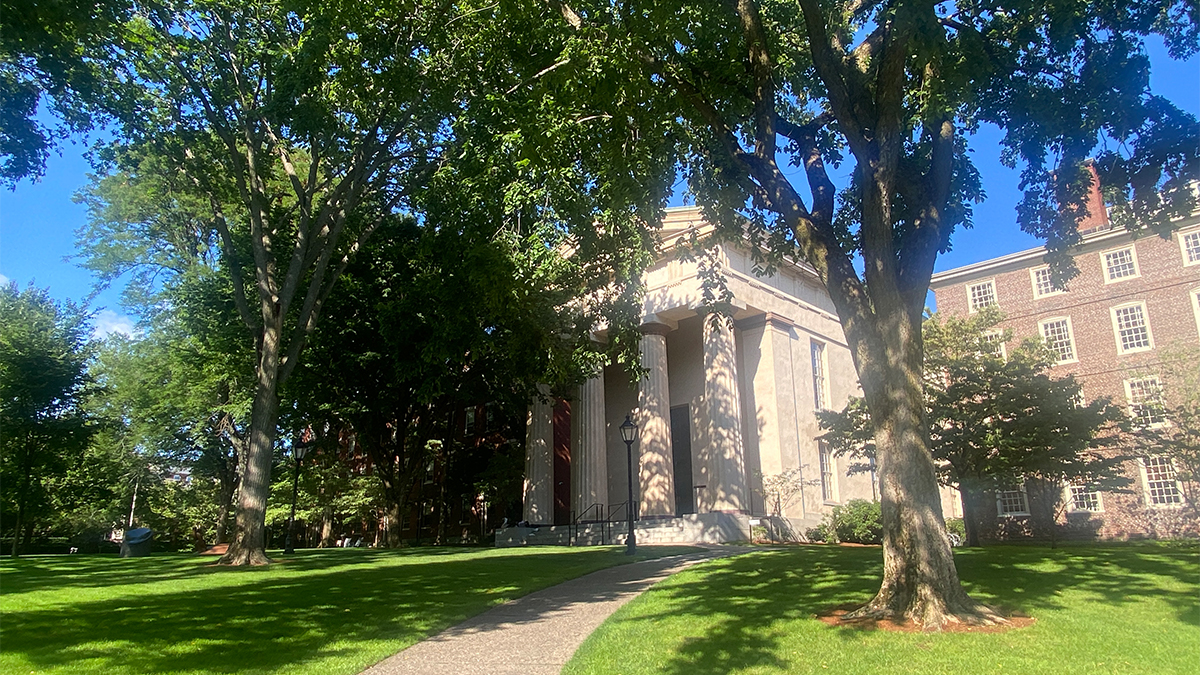
Woven into the College Hill neighborhood, this irregularly shaped, 146-acre campus developed incrementally since its establishment in the late eighteenth century. In 1770 the institution acquired an eight-acre property and erected a building (now University Hall) overlooking the city. Additional buildings followed, arranged in a row facing the Front Green—a sloping lawn which by the mid-nineteenth century was edged by a perimeter fence, traversed by gravel walks, and planted with elm trees. Between 1862 and 1891 four additional buildings were erected in a parallel row to the east, forming a quadrangle (now College Green). In 1901 a wrought iron perimeter fence was erected, featuring the Van Wickle Gates by architects Hoppin & Koen and Hoppin & Ely sited along the Front Green on axis with University Hall. Concurrently the institution engaged Olmsted Brothers to design Lincoln Field—then the easternmost section of campus. Frederick Law Olmsted, Jr., proposed a graded quadrangle (now Ruth J. Simmons Quadrangle), framed by buildings and distinguished by an amphitheater.
In 1922 architect Paul Cret prepared a campus plan; by the late 1930s the campus expanded north and south. The university engaged Mary Elizabeth Sharpe and landscape architects Sasaki, Walker and Associates (now Sasaki), to undertake master plans in 1940 and 1963 respectively.
Today the historic campus core is characterized by quadrangles traversed by straight and curvilinear paths shaded by mature deciduous canopy trees including elm and oak. The Front Green includes a sculpture, Slavery Memorial (2014) by Martin Puryear, whereas the Simmons Quadrangle is distinguished by the Stephen Sondheim Amphitheater (2025), designed by Stoss Landscape Urbanism sympathetic to Olmsted's earlier vision.
The Brown campus contains five buildings listed in the National Register of Historic Places, two of which are designated National Historic Landmarks. The campus is also overlaid with five National Register historic districts with many campus buildings contributing features within these districts.