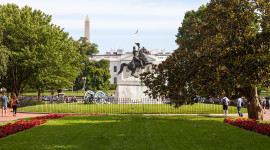
ACLU Weighs in on Plans to Permanently Fence Off Lafayette Park, Ground Zero for First Amendment Protected Rights
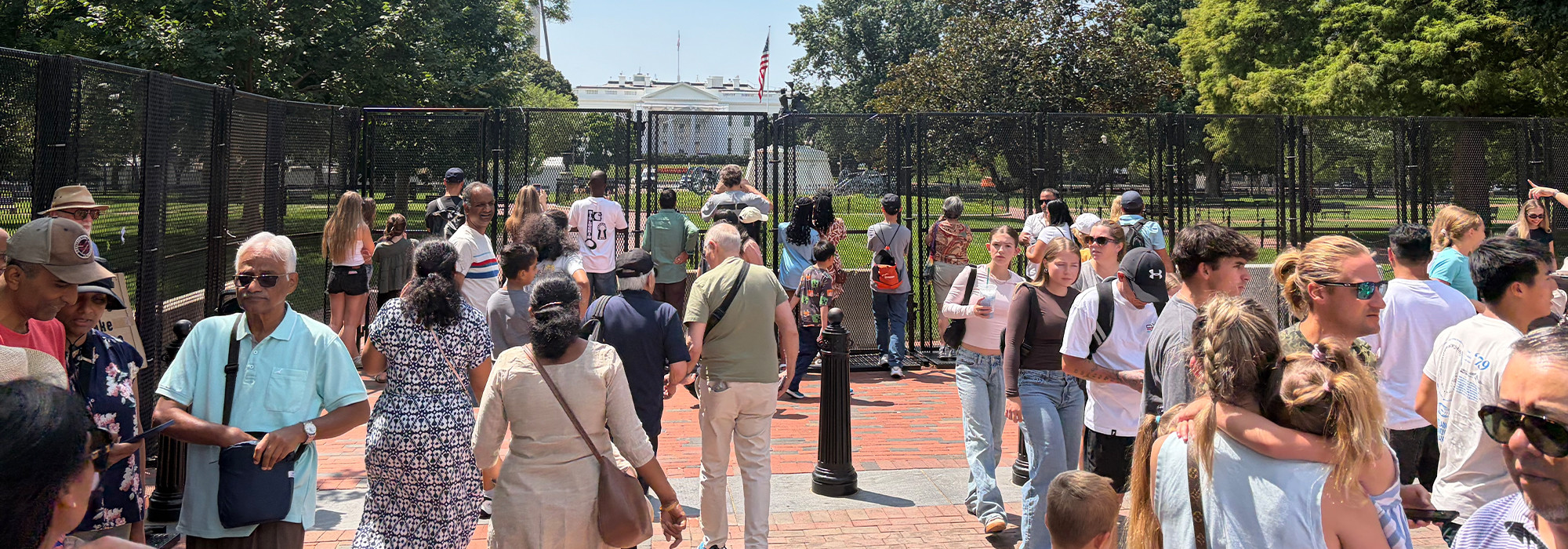
Editor's note: The proposal to erect a permanent ten-foot-tall metal fence around Lafayette Park (across Pennsylvania Avenue from the White House) has caused considerable concern. The park, a National Historic Landmark, is Ground Zero for First Amendment protected rights and the site of peaceful public protest from the Suffragette Movement to Black Lives Matter. The proposal is currently under federally mandated reviews pursuant to Section 106 of the National Historic Preservation Act, which seek to identify potential “adverse effects” the fence would cause and how to “avoid, minimize, or mitigate” those negative impacts. The National Park Service (NPS), which manages Lafayette Park, recently held the first Section 106 “consulting party” meeting on August 12, 2026, to examine the proposal—here’s a link to the presentation deck and to a video of the meeting. Following the meeting, The Cultural Landscape Foundation (TCLF) sent comments about the proposal on August 25, 2026. TCLF also encouraged the Washington, D.C. chapter of the American Civil Liberties Union (ACLU) to become a consulting party to the process. Below are the comments they submitted to NPS on August 26, 2026.
Ms. Tammy Stidham
Associate Regional Director - Lands and Planning
National Park Service
1100 Ohio Drive SW Washington, DC 20242
Via email to tammy_stidham@nps.gov
Re: Proposed Lafayette Park Security Modifications - Consulting Party Meeting #1
Dear Ms. Stidham,
Thank you for convening the Consulting Party Zoom meeting on August 12 regarding the Proposed Lafayette Park Security Modifications, July 16, 2026 (the “Proposed Modifications”). Consulting Party American Civil Liberties Union of the District of Columbia respectfully submits these questions and comments relating to that meeting.
I.
The American Civil Liberties Union of the District of Columbia is marking its 65th anniversary this year. For all of that time, it has focused on protecting First Amendment rights in the Nation’s Capital, including specifically in Lafayette Park and the White House area. During that time, the Secret Service has repeatedly pressed for greater limitations on public use of and access to Lafayette Park, yet when such limitations have been rejected, Presidential safety has not been threatened.
The most obvious example goes back to 1967, when the National Park Service (NPS) decided to limit gatherings on the White House sidewalk to groups not exceeding 100 persons, and to limit gatherings in Lafayette Park to groups not exceeding 500 persons—limits that were assertedly necessary to protect the security of the President. See A Quaker Action Group v. Morton, 516 F. 2d 717, 721, 726 (D.C. Cir. 1975). After much litigation, including a trial, the court of appeals ruled that groups of at least 750 persons must be allowed to assemble on the White House sidewalk and that groups of at least 3,000 persons must be allowed to assemble in Lafayette Park. id. at 731, and that those limits must be waived in appropriate circumstances. Id. at 732. Despite the fact that these minimum limits in Lafayette Park that are six times larger than the Secret Service asserted could safely be allowed, there have been no events in Lafayette Park in the past 50 years that have actually threatened the President in the White House.
Fast forward 51 years, and the Secret Service asserted that a peaceful demonstrator’s flag saying “8647” on Constitution Avenue near Third Street, NW, posed a threat to the security of the President. After considering evidence including a declaration by the Deputy Director of the Secret Service, the district court rejected that assertion. Accountability NOW USA v. Griess, 2026 WL 1870626 (D.C.C. June 29, 2026). The flag has continued to wave and the President has not been harmed or even threatened on account of it.
We therefore posit that Secret Service assertions about what presidential security demands are not Holy Writ. It is the responsibility of the National Park Service and the other institutions that review the proposed project to make independent, evidence-based judgments about the need for such a fence, in light of the other criteria they are required to consider.
II.
“[T]he right of the people peaceably to assemble, and to petition the Government for a redress of grievances” is so fundamental to our freedoms that the States that ratified the Constitution insisted that it be added to that document in 1791 as part of the Bill of Rights. The exercise of that right was not left to the discretion of government bureaucrats, including the National Park Service and the Secret Service.
As NPS recognizes, Lafayette Park and the White House area are unique, historic sites for First Amendment-protected protest activity. Proposed Modifications at 4 (“a vital venue for First Amendment activity.”). People routinely come to those areas to demonstrate or to celebrate because of the expressive significance of making their voice heard at the front door of the People’s House within sight and sound of the President and other Executive Branch officials.
Demonstrations in Lafayette Park have almost always been peaceful—from the Suffragists more than 100 years ago, to the spontaneous celebration of the killing of Osama bin Laden, to the Peace Vigil that stood in the park for more than forty years. None of the many assassinations and attempted assassinations of Presidents have had any link to Lafayette Park. In the Proposed Security Modifications, NPS points only to “several examples of assembles that elevate into non-peaceful demonstration which have resulted in violence towards law enforcement officers maintaining the necessary stand-off from restricted areas and vandalism to NPS resources throughout Lafayette Park.” Proposed Modifications at 26. There are also some photographs of graffiti and of a failed attempt to pull down the Jackson statute. Id. There is no suggestion that there have been any attempts to harm the President from Lafayette Park.
NPS also asserts that “[a] well-designed permanent fence would … general [sic] enhance public safety for visitor [sic] in the area and ensure safety crowds [sic] gathering to demonstrate in view of the White House.” Id. at 26. But it offers no explanation for these claims, which are implausible; given the 24/7 presence of Park Police and Secret Service officers in and near the Park, neither tourists nor demonstrators face unsafe conditions in the Park.
III.
The proposed permanent fence will meaningfully impair the Park’s accessibility, both physically and in the reasonable view of members of the public, and will therefore significantly interfere with its historical and present value as one of the most important, if not the most important, location in the Nation for First Amendment activity.
The Proposed Modifications claim that a fence will “preserve[] day-to-day openness.” Id. at 4. But even when the gates are open, the very presence of a fence will send a clear message to the public that the park is only open by permission, and that permission may be withdrawn at any moment. People who wish to exercise First Amendment rights in the Park will sensibly fear that NPS and the Secret Service—both of which are ultimately directed by the President—will have essentially unfettered discretion to close the Park at will, both to prevent demonstrations and to “kettle” demonstrations already underway. Demonstrations of greater than 25 persons in the Park require advance planning and permits. 36 C.F.R. § 7.96(g)(2). Why would any group plan for a demonstration in the Park, knowing that when they arrive they may find the gates closed, or that after they have assembled they may be trapped?
As the Nation has seen over the last nineteen months, the incumbent administration will do almost anything—lawful or unlawful—to stifle unwelcome speech. For more than eight months, this administration has chosen to close the park entirely, including now, when all repairs and tree plantings appear to have been completed. There is every reason to anticipate that this administration, and potentially future administrations, will choose to close the gates of a fence permanently, or indefinitely, in order to avoid hearing the voice of the public on matters of public concern. It is virtually certain that this administration will close the gates whenever it expects a demonstration critical of the President or his policies, under the guise of security. After all, this administration believes that demonstrators displaying flags saying “8647” are threats to the physical safety of the President, even when they are several miles away from the White House. See Accountability NOW USA v. Griess, 2026 WL 1870626 at *15 (D.D.C. 2026) (“the Deputy Director of the Secret Service attests that he generally ‘regard[s] the statement “86-47” as a potential call for acts of violence directed at the President of the United States’ and that he ‘understand[s] “86” to represent a euphemism for acts of physical violence.’”) The Park Service and the Secret Service can offer no guarantees to the contrary.
IV.
In presenting the Proposed Modifications, NPS takes the position that leaving the current portable, temporary fencing in place forever is the default option. Proposed Modifications at 63. That is not a sensible position. When that fencing was installed in January 2026 it was explicitly a temporary measure, to protect the park and the public while necessary repairs and improvements were made. Meridian Hill (Malcolm X) Park and Columbus Circle were temporarily closed at about the same time for the same reason. Those areas have reopened and the temporary fencing has been removed. The temporary fencing that now surrounds Lafayette Park is not even intended to remain in place until a permanent fence is constructed; the decision whether to keep it up or remove it is made one month at a time. The fence is currently in place in response to a letter dated July 23, 2026, from the Chief of the Secret Service to the Regional Director of the National Park Service, which states:
The Secret Service anticipates restricting public access to the above-indicated areas beginning on Saturday, August 1, 2026, at approximately 12:00 a.m. to Monday, August 31, 2026, at approximately 11:59 p.m.… The Secret Service will continually reassess the situation and notify you as soon as practicable if it is determined these closures can be lifted sooner.
As of now, therefore, the Park will return to its historic condition of openness, with no fencing, on September 1, 2026. Pretending that the temporary fencing around Lafayette Park is the “no action alternative” here improperly seeks to avoid considering the Park’s historically significant public access, freedom of movement and visually open character (offering views and visual connectivity to the White House) as the basis of comparison with the proposed new fence.
The Proposed Modifications also fail to explain why the proposed new fence is necessary for Presidential security. What is the threat that is now unaddressed that the new fence will address? Why aren’t the existing White House fence—recently rebuilt to be taller, stronger, and more scale-proof—and the manifold other security measures in place around the White House, adequate? If the fear is that a crowd will rush across Pennsylvania Avenue and attack the White House, and that the existing fence somehow would not prevent that, why wouldn’t a fence along the south side of Lafayette Park address that concern? During the Consulting Party Zoom meeting, the Secret Service presenter stated that the Park is sometimes closed for short periods of time, multiple times a day. Have those short closures not been successful? Why are they not adequate?
The White House is a very safe place for the President. Providing absolute safety is an unattainable goal, and safety is constantly balanced against other interests that are desirable to the President and the American People, such as attending far flung political rallies and sports events at which he is in close proximity to hundreds or thousands of people. The right of the American People to exercise their right of free assembly and expression in proximity to the White House may be something the President does not desire or wish to tolerate, but it is of greater constitutional value than the NCAA Division I Men’s Wrestling Championship. And the President’s desire not to see or hear unwelcome speech is of no constitutional value at all. The Park Service must give “the right of the people peaceably to assemble, and to petition the Government for a redress of grievances” greater weight than adding some unexplained, barely marginal improvement to the safety of the President when he is safely in the White House.
Very truly yours,
Arthur B. Spitzer
Senior Counsel
Laura K. Follansbee
Staff Attorney
Related Content
Lafayette Park - D.C.
Washington, DC
White House Grounds
Washington, DC
US taxpayers set to provide millions for Trump’s 'beautification' efforts in DC
Scripps News and more than 40 other media outlets