


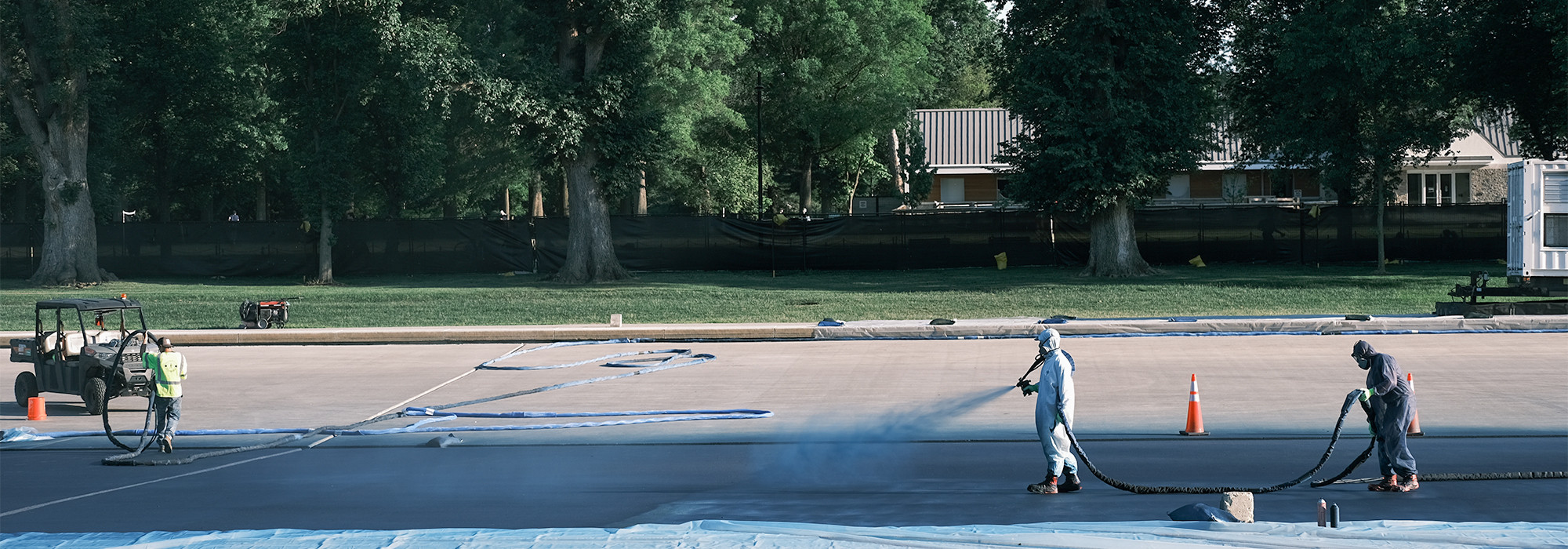
Federally Mandated Review Process was Improperly Streamlined in Reflecting Pool Repainting Project According to New Filing from The Cultural Landscape Foundation
Media Contact: Nord Wennerstrom | T: 202.483.0553 | M: 202.255.7076 | E: nord@tclf.org
The Washington Litigation Group represents the foundation
Washington, D.C (May 20, 2026) – The Cultural Landscape Foundation (TCLF), a national Washington, D.C.-based education and advocacy non-profit organization established in 1998, today filed a reply in the lawsuit against the U.S. Department of the Interior (DOI) claiming the current application of blue paint to the basin of Reflecting Pool on the National Mall is being done in violation of federal law. TCLF is represented by the Washington Litigation Group. The reply demonstrates how the National Park Service, which part of DOI and responsible for the Reflecting Pool and the National Mall, admitted that they improperly streamlined legally required reviews to speed up the painting project. TCLF is seeking a temporary restraining order and/or preliminary injunction to stop the work. Changing the Reflecting Pool’s color, a key character-defining feature of the site, which is listed in the National Register of Historic Places, should be subject to reviews pursuant to Section 106 of the National Historic Preservation Act of 1966 and other laws. NOTE: A hearing on the emergency motion will be on Thursday, May 21, 2026, at 2 p.m., in Courtroom 17 of the U.S. District Court for the District of Columbia.
As TCLF’s latest filing states: “The streamlined [Section 106] review process is reserved for routine projects that do not change the historic features of a property, which the ongoing painting plainly does … Defendants’ own documents state that they knew the repainting was not eligible for streamlined review. Instead, Defendants are willfully violating the law because they felt political pressure from “White House leadership” to operate on a lightning-fast timeline. Because the passage is so damning, we reproduce it in full:
While normally not eligible for Streamlined Review due to the change to an epoxy coating, given the direction provided by [National Park Service], [Department of the Interior], and White House leadership coupled with the timeline required to complete compliance, there is no option other than to select Streamlined Review. No Streamlined Activity clearly aligns with this undertaking . . . . Consultation with the DC [State Historic Preservation Office] would probably result in non-concurrence with an agency official proposed finding of No Adverse Effect. Significant and timely consultation would be required to reach consensus with the SHPO of a No Adverse Effect finding based on the historic precedent of tinting the pool bottom. [emphasis added].
Here is a link to the reply. Additional filings in this case can be found on the CourtListener website.
The achromatic/grey of the Reflecting Pool’s basin has been a signature feature since the site opened in 1924. According to an NPS Cultural Landscape Report about the Reflecting Pool in August 1999 (p.33), the basin consisted “of an asphalt coated membrane, slate, and concrete tile. The dark color of the tile created the illusion of greater depth and a more profound reflection.” Work on the Reflecting Pool and other aspects of the Lincoln Memorial and its grounds have been subject to Section 106 reviews previously, as well as reviews by the U.S. Commission of Fine Arts (CFA).
“These documents show why federal regulations require agencies to conduct deliberate, consultative reviews that engage experts in the field and the public. It’s stunning to see the National Park Service ignore and skirt its responsibilities for a national treasure legally entrusted to their care,” said Charles Birnbaum, TCLF’s President and CEO.
Birnbaum added: “We are grateful to the Washington Litigation Group, and especially Alexander Kristofcak, Counsel, and Joseph Mead, Senior Counsel, for taking on this case. The National Mall and other treasured examples of our nation’s shared patrimony are safeguarded by the rule of law, which we believe should be enforced.”
TCLF’s Birnbaum spent fifteen years at the National Park Service as Coordinator of the Historic Landscape Initiative (1992-2007) during which time he authored The Secretary of the Interior’s Standards for the Treatment of Historic Properties with Guidelines for the Treatment of Cultural Landscapes (1996), which directly informs the Section 106 review process. TCLF is currently a consulting party to Section 106 reviews of the White House Visitor Center, Lafayette Park, and Pennsylvania Avenue and has requested consulting party status to any Section 106 reviews of the proposed Triumphal Arch, the National Garden of American Heroes in West Potomac Park, and the new golf course at East Potomac Park.
About the Washington Litigation Group
Founded in August 2025, the Washington Litigation Group is a nonpartisan non-profit boutique law firm dedicated to defending the rule of law. The firm is led by some of the most distinguished members of the D.C. legal community. It defends individuals and institutions under attack and brings litigation to combat government overreach.
* Alexander Kristofcak is admitted only in California and New York and is practicing under the supervision of D.C. Bar members.
About The Cultural Landscape Foundation
The Cultural Landscape Foundation (TCLF) is a 501(c)(3) non-profit founded in 1998 with a mission of “connecting people to places.” TCLF educates and engages the public to make our shared landscape heritage more visible, identify its value, and empower its stewards. Through its website, publishing, lectures, and other events, TCLF broadens support and understanding for cultural landscapes. TCLF is also home to the Cornelia Hahn Oberlander International Landscape Architecture Prize.
NOTE: All media inquiries about this lawsuit should be directed to Alexander Kristofcak, Counsel, Washington Litigation Group. E: akristofcak@washingtonlitigationgroup.org T: (202) 521-8734
# # #