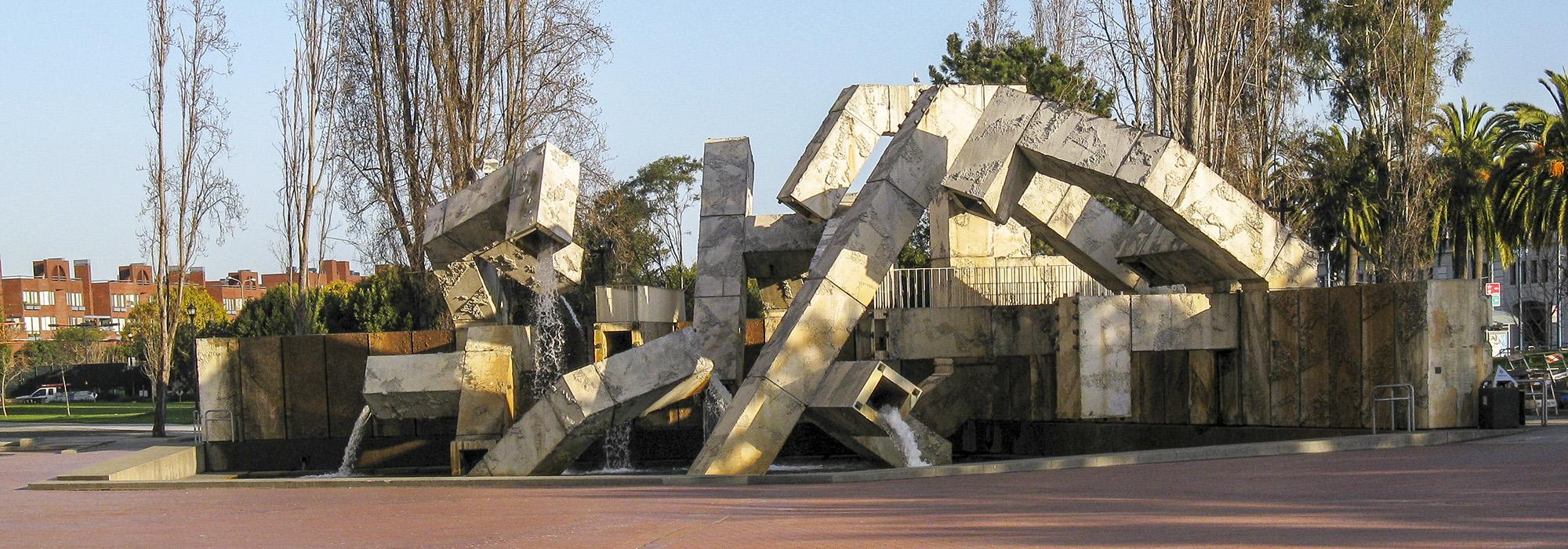
New information raises transparency issues in Vaillancourt Fountain debate
A recently obtained meeting recording (passcode: c@$7n$Y0) and transcript offer bracing insights into what San Francisco city officials have to say about advocates for the iconic and threatened Vaillancourt Fountain and Embarcadero Plaza, transparency and public process, and messaging in a campaign to convince philanthropists to donate $15 million to help finance a replacement park. The material was included in the agenda for a November 21, 2025, meeting involving members of the San Francisco Recreation and Park Department (RPD), the real estate developer BXP, the Downtown San Francisco Partnership, and the city's Office of Economic & Workforce Development. More on that in a moment.
Readers may wonder why The Cultural Landscape Foundation (TCLF) is wading through these documents and recordings. What’s the big picture? TCLF’s focus here, and in other advocacy issues, is on public stewardship—the responsible, ethical management of public resources, systems, and trust for the long-term benefit of all people, meaning leaders and citizens act as caretakers, prioritizing collective well-being and future generations over short-term gain or self-interest. As an education and advocacy organization, TCLF aims to promote sound, informed stewardship, and transparency in public process.
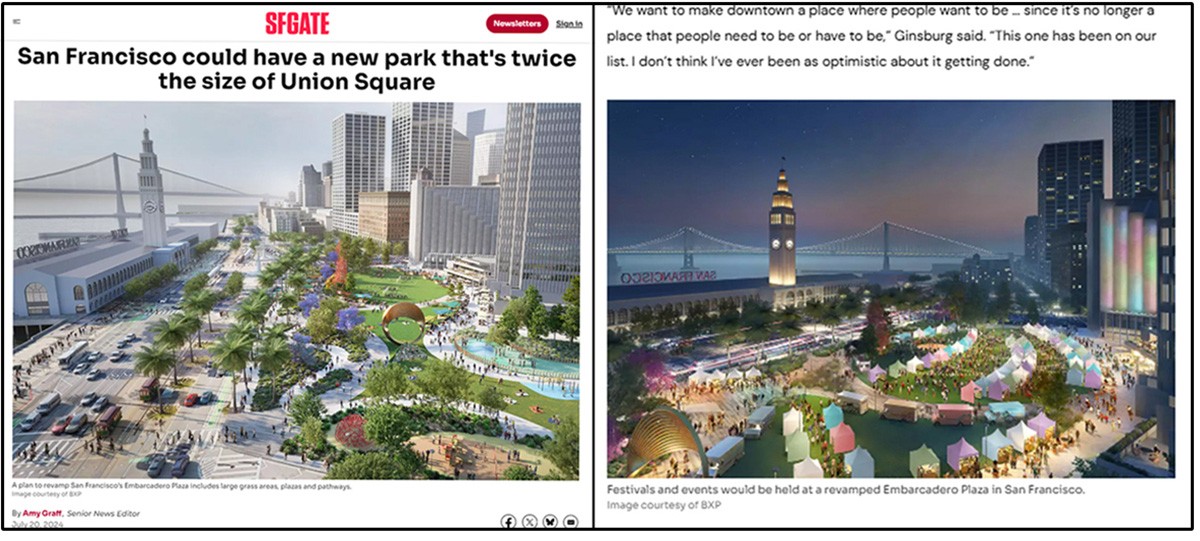
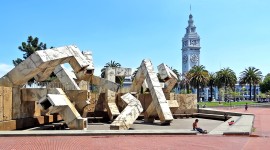
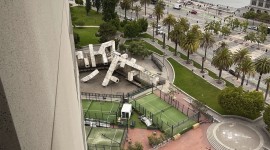
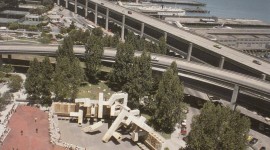
As TCLF has previously written, the city, at the behest of the real estate developer BXP, which is the largest commercial landlord in the city and owns Embarcadero Center next to the plaza, wants to demolish the fountain, and redevelop both the plaza and neighboring Sue Bierman Park; the city’s Recreation and Park Department is the lead agency in the effort.
City officials had been pushing for the fountain’s outright demolition; however, members of the San Francisco Arts Commission (SFAC), which owns the Vaillancourt Fountain, seemed skittish at the prospect and instead on November 3, 2025, voted eight to five to disassemble the artwork and put it into storage; this would clear the way for RPD to redevelop the site. The Docomomo US/Northern California Northern chapter (Docomomo NOCA) filed an appeal on December 1 challenging the pretext for the vote. A hearing before the city’s Board of Supervisors is scheduled for January 13, 2026.
The cost of a new park adjacent to BXP’s real estate holdings is now estimated at $34 million and city officials are working with the consulting firm CCS Fundraising on a campaign to raise $15 million. The recently obtained recording (passcode: c@$7n$Y0) and 52-page transcript mentioned above come from a September 30, 2025, meeting led by CCS Fundraising Managing Director, Travis Carley that included RPD General Manager, Phil Ginsburg, RPD Director of Partnerships, Lisa Bransten, CSS staffer Tulse Chowdhury, and Downtown SF Partnership President & CEO, Robbie Silver.
At this point it’s essential to point out that an ethics waiver must be issued by the Board of Supervisors to allow city “officers and designated employees” to fundraise for specific projects. A six-month long waiver was granted on March 21, 2025, authorizing Ginsburg, Bransten, the mayor, and certain “staff in the Mayor's Office ... to solicit donations for the renovation of Embarcadero Plaza and Sue Bierman parks from individuals, nonprofits, private organizations, grantmakers, and foundations.” Six months is the maximum allowed for a waiver, but it can be renewed.
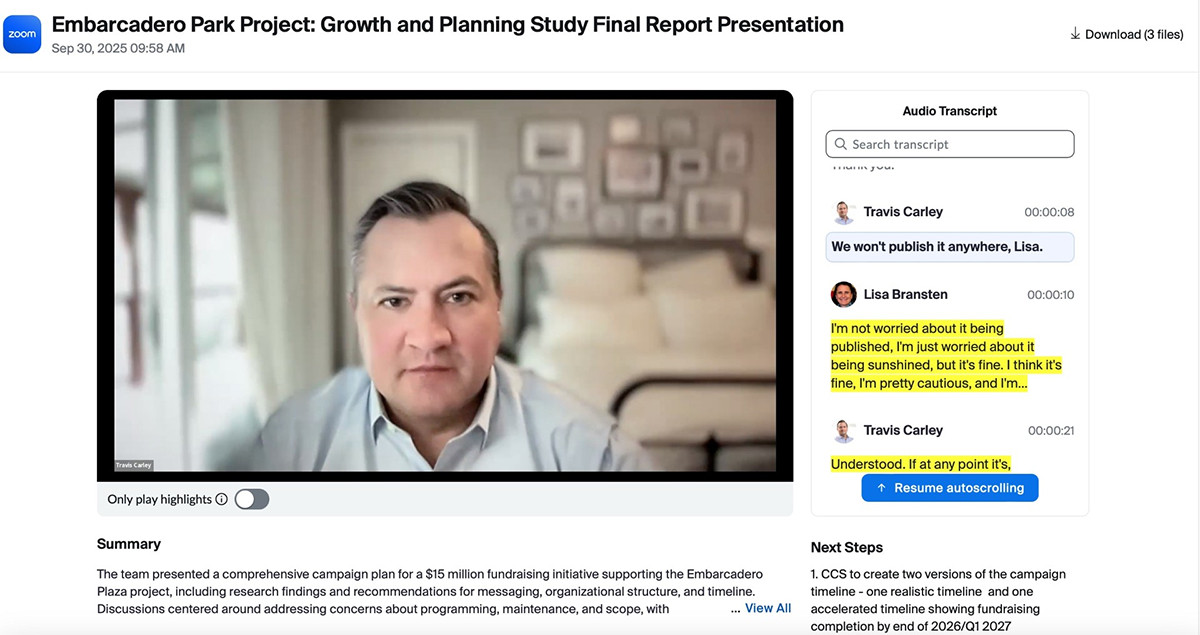
The meeting participants spent approximately an hour discussing fundraising strategies, messaging vulnerabilities, the urgency to quickly deliver results, and other matters. However, the recording gets interesting—and revelatory—in the seconds before CCS’s Carley introduces the presentation; there is this exchange between him and Bransten in which they appear to discuss shielding information from public disclosure:
Travis Carley: We won't publish it anywhere, Lisa.
Lisa Bransten: I'm not worried about it being published, I'm just worried about it being sunshined, but it's fine. I think it's fine, I'm pretty cautious, and I'm…
What did they not want published? And why were they worried about being “sunshined,” i.e., revealed through a public records request? What would public disclosure of this information show? And is this indicative of how CCS and city officials work together and their views of public disclosure?
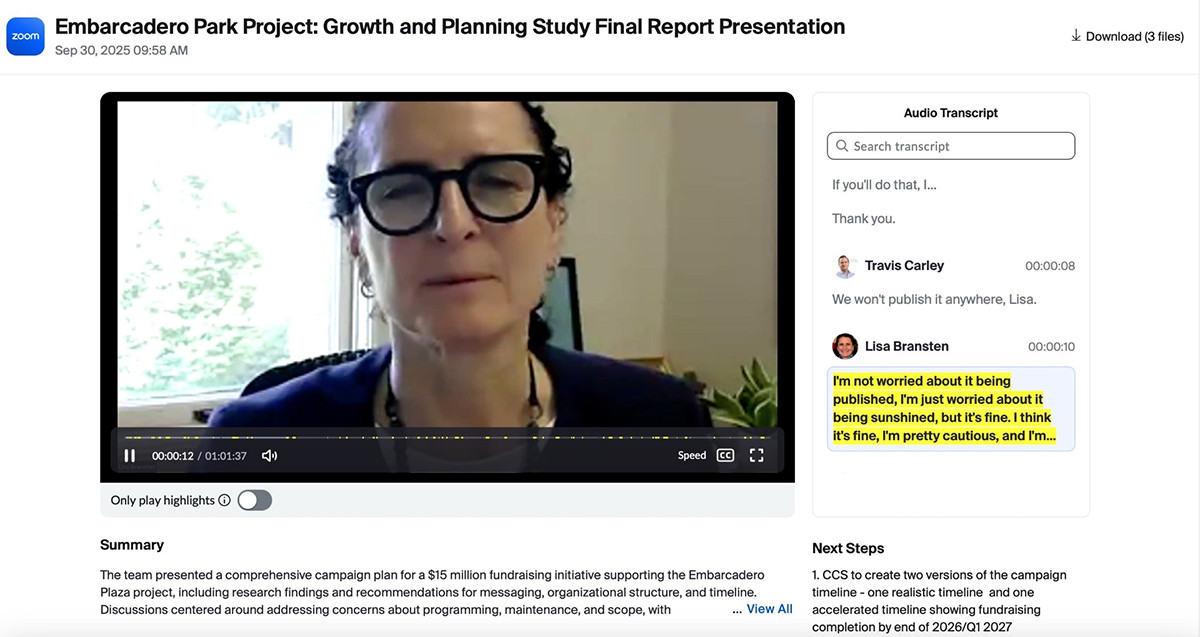
Midway through the presentation is another startling remark, this time from Ginsburg:
The six-month waiver is stupid. It needs to be longer, because when you bump up against the 6 months ... we've now created a political opportunity for the Vaillancourt Fountain folks and the haters to make their voices heard in a political forum.
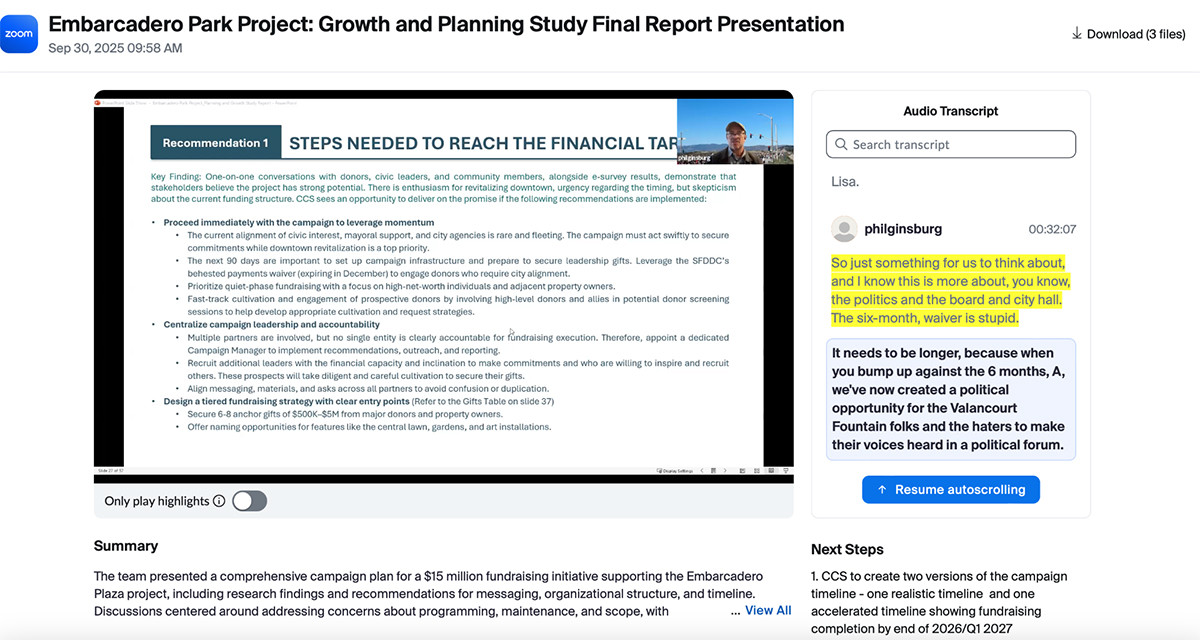
This antipathy to the process and its participants is unnecessary and unseemly, and perhaps bespeaks his own frustration to make a compelling argument.
The PowerPoint presentation discussed in the meeting included the results of a CCS-commissioned survey and recommendations for the $15 million capital campaign. Despite the “overwhelmingly positive responses from more than 90% of the [21] stakeholders” interviewed, as Chowdhury noted, there were serious concerns from the stakeholders:
1. “many are still unclear on the broader civic value. They're often asked, is this really the city's priority?”;
2. “programming was mentioned as critical to the mission of this project.” Stakeholders pointed to programming successes at Tunnel Tops at San Francisco’s Presidio, Millennium Park in Chicago, and Bryant Park in New York City. Chowdhury later reinforced that “there is a strong call for clearer programming plans, so people want to see more articulated, thoughtful, community-driven programming that reflects the diversity of downtown users”;
3. “maintenance and stewardship were also top of mind;
4. “the plan is too focused on the area near BXP’s buildings.”
On programming, Ginsburg seemed relatively unconcerned saying: “The programming is going to work out just fine. Between what Rec and Park does, we program the hell out of our spaces."
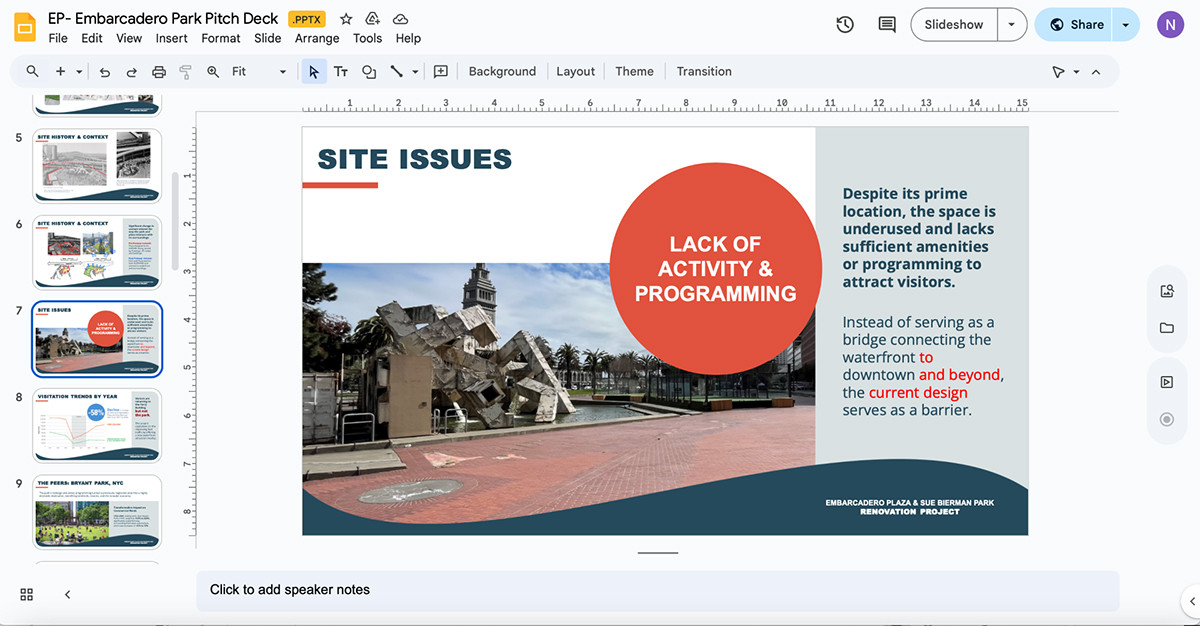
But a PowerPoint “pitch deck” included in a December 5, 2025, Embarcadero Plaza Project, Fundraising Committee meeting included information explicitly contradicting Ginsburg. A slide (above) labeled “Lack of Activity & Programming” specifically says: “Despite its prime location, the space is underused and lacks sufficient amenities or programming to attract visitors.” The presentation has since been updated and the “Lack of Activity & Programming” slide has been removed.
In the September meeting Ginsburg seemed to brush aside the stakeholders’ call for more “articulated, thoughtful, community-driven programming” by saying: “Just for messaging standpoint, just take a look at, you know, either Bryant Park or Millennium Park, copy a schedule, and say, this is the programming we envision. Boom, done. It doesn't really need to be much more than that.”
As to maintenance, Ginsburg is sensitive to criticism that his agency doesn’t do a good job. In the September meeting he said: “The maintenance and stewardship stuff. That particularly gets my goat. Our organization has an incredible track record of maintaining and stewarding and taking care of our properties.”
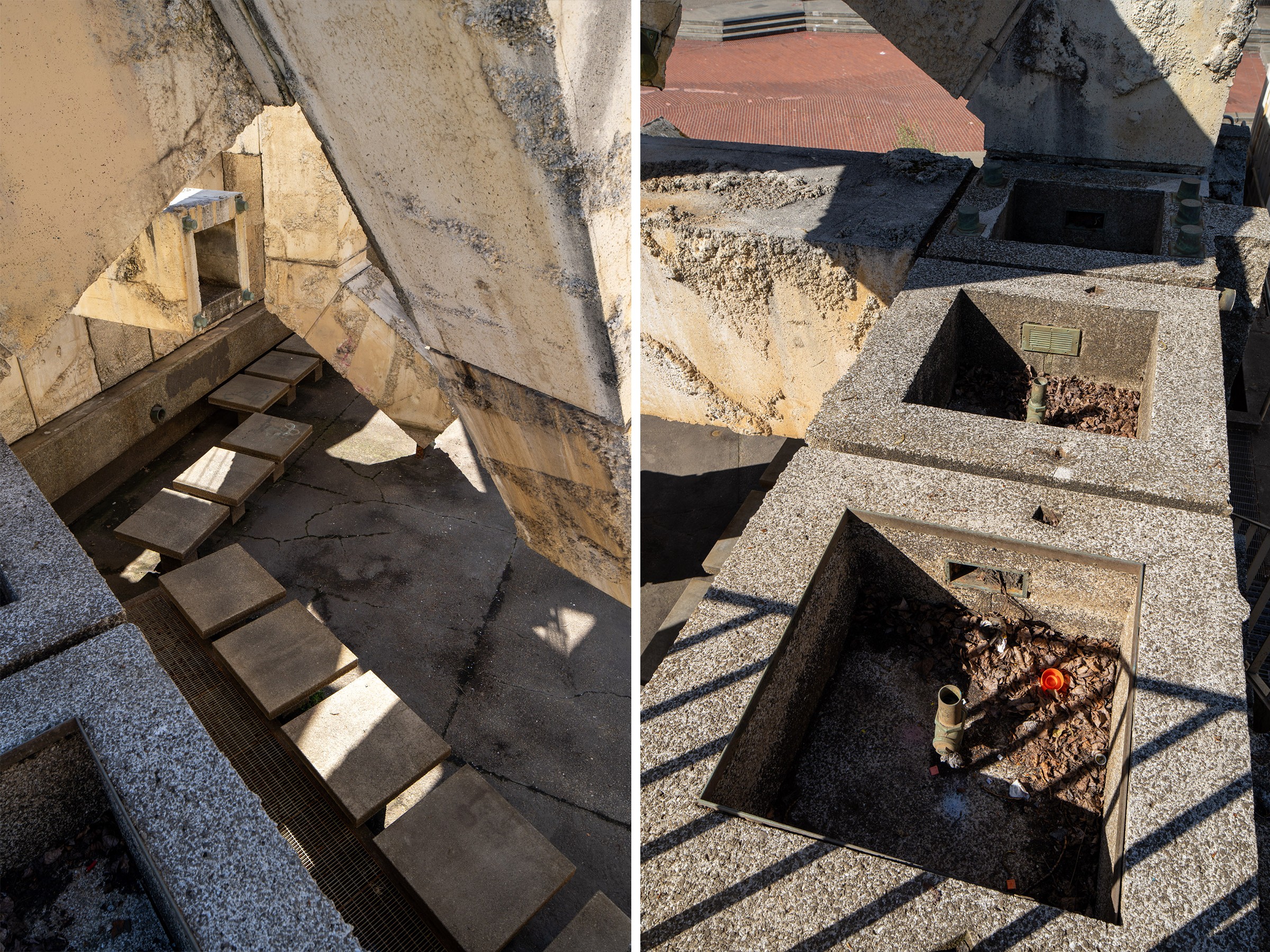
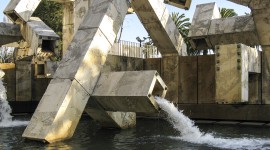
The well-documented and very compromised condition of the Vaillancourt Fountain fundamentally undermines that assertion. Moreover, as TCLF first reported, in a written statement to the SFAC and in media interviews Ginsburg and RPD officials inflated the amount spent annually on the fountain’s maintenance by some 250%.
It’s also not hard to see that BXP has been a prime driver and would be the primary beneficiary of the redevelopment. As Ginsburg said during an October 17, 2024, Recreation and Park Commission meeting, he started having conversations with BXP officials about redeveloping the Halprin-designed Embarcadero Plaza "eight to ten years ago.” Ironically, eight years ago Ginsburg was publicly praising Halprin’s legacy, which was the subject of a TCLF-organized and curated traveling photographic exhibition about Halprin that was shown at the Palace of Fine Arts. And, Ginsburg noted that Embarcadero Plaza, then known as Justin Herman Plaza (until its renaming in 2017), was in RPD’s portfolio and under its jurisdiction.
RPD’s partnership director Bransted and others are plowing ahead. The agenda for the December 5, 2025, Embarcadero Plaza Project, Fundraising Committee meeting included a matrix of naming opportunities for the new park—ranging from $10,000 for a bench, up to $1 million for a dog park, and $5 million for the stage—and the draft of a letter to the San Francisco Downtown Development Corporation Board asking for $20 million. It’s also clear from the September meeting that they’re under pressure. While CCS’s Carley recommended a longer campaign, Bransten said: “We need to be fully funded by the end of 2026. That's when we promised bulldozers in the ground.”
Thus far, proponents of the plaza’s redevelopment have failed to offer a clear and compelling narrative about the project’s broader civic value beyond the benefits to BXP. Similarly, having already failed, by their own admission, to develop a compelling, site-specific programming agenda, how will they do so with a new park? And, their maintenance track record (with its exaggerated annual budget at Embarcadero Plaza) does not inspire confidence. Perhaps most disconcerting is the seeming willingness of one of the city’s contractors and a city official to keep information from becoming publicly available. If public stewardship is the goal, then transparency is essential.