URGENT – Public Comments Needed by June 15 about the Triumphal Arch in Washington, D.C.
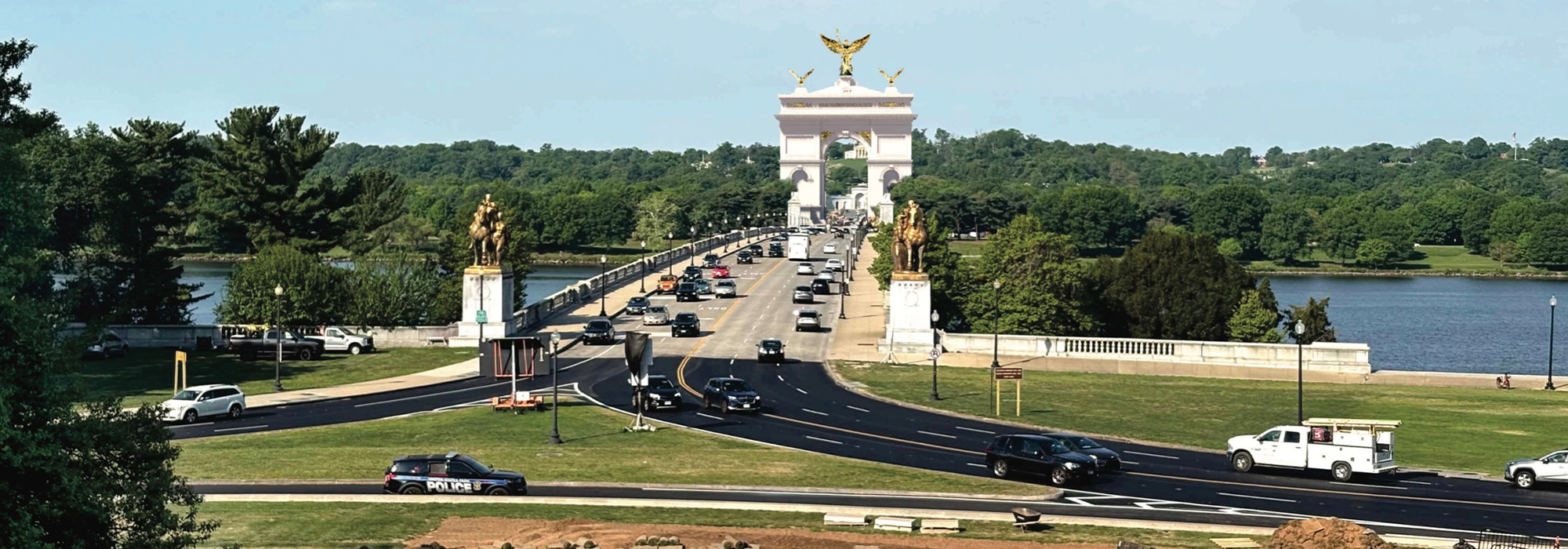
With little fanfare, a critical federal level review was initiated on Friday, June 5 for the 250-foot-tall Triumphal Arch that would be built between the Lincoln Memorial and Arlington National Cemetery; and, remarkably, the public comment period closes on Monday, June 15. So, please submit comments right away—at the end of this article is a hot link to where comments should be submitted.
The review under Section 106 of the National Historic Preservation Act is designed to identify how the project could cause negative impacts (or as the feds call it, adverse effects) and how to “avoid, minimize, and mitigate” those negative impacts. The Cultural Landscape Foundation’s (TCLF) recent article Why is the National Park Service Helping the Administration Evade the Law? reveals how the National Park Service (NPS) is twisting, contorting, and manipulating the Section 106 process to fast-track projects such as painting the Reflecting Pool on the National Mall.
Now, NPS has hit the gas pedal on the reviews for the Triumphal Arch by compressing the public comment timeframe to a mere ten days. All of the documents concerning the proposed Arch can be found here.
In addition, as noted in TCLF’s article, organizations and individuals that are subject area experts and normally participants in the review process are currently being excluded; this includes TCLF, the National Trust for Historic Preservation, D.C. Preservation League, and others. According to the draft Programmatic Agreement (essentially a final contract): The [Arch’s construction] will be consistent with … the Secretary of the Interior’s Standards and Guidelines for the Treatment of Cultural Landscapes …” and other regulations. Since TCLF’s Founding President & CEO, Charles A. Birnbaum, authored the Guidelines for the Treatment of Cultural Landscapes during his fifteen-year tenure (1992-2007) at NPS, it seems odd that TCLF’s request to be a “consulting party” to the review process has not been approved.
In recent comments submitted to the National Capital Planning Commission, an agency reviewing the Arch project, TCLF stated: “The proposed arch interrupts and severs key visual and spatial relationships that are integral to the Monumental Core’s design intent and its inherent symbolism.”
According to the National Park Service the present Memorial Bridge was “Symbolically … designed to show the strength of a united nation by joining a memorial on the north side of the Potomac River (the Lincoln Memorial) with one on the south (Arlington House, the Robert E. Lee Memorial). The architect [of Memorial Bridge] envisioned an elaborate sculptural program … including seated figures of the first four American presidents on the D.C. side and reclining statues of oceans and river gods on Columbia Island. The bridge itself was to have forty allegorical statues.” That entire sculptural program was eliminated by the U.S. Commission of Fine Art, another regulatory agency, as some statuary and pylons were seen as too tall in relation to the memorial.
The Lincoln Memorial is a hinge point (on a bent axis) visually connecting the Washington Monument and the Reflecting Pool to the east, and Arlington House. The Historic American Engineering Record report of 1988 about Arlington Memorial Bridge by historian Elizabeth Nolin noted: “As the final link in the chain of monuments which start at the Capitol building, the Arlington Memorial Bridge connects the Mall in Washington, D.C. with Arlington National Cemetery in Virginia. Designed to connect, both physically and symbolically, the North and the South, this bridge, as designed in the Neoclassical style, complements the other monumental buildings in Washington such as the White House, the Lincoln Memorial, and the Jefferson Memorial.”
The Triumphal Arch would radically alter the visual and spatial relationships of a landscape listed in the National Register of Historic Places and insert a huge barrier between Arlington House and Arlington National Cemetery and the Lincoln Memorial.
The deadline for submitting comments is Monday, June 15—do not wait. Send in your comments now.
Related Content

Lincoln Memorial Grounds
Washington, DC
Arlington National Cemetery
Arlington, VA
U.S. Capitol Grounds
Washington, DC