


The Cultural Landscape Foundation Releases Two Design Provocations for Alternatives to a 250-foot-tall Triumphal Arch to Commemorate the Nation’s 250th Anniversary
Media Contact: Nord Wennerstrom | T: 202.483.0553 | M: 202.255.7076 | E: nord@tclf.org
Design provocations highlight the essential role of meaningful public input just as Congress prepares this week to eviscerate Section 106 of the National Historic Preservation Act
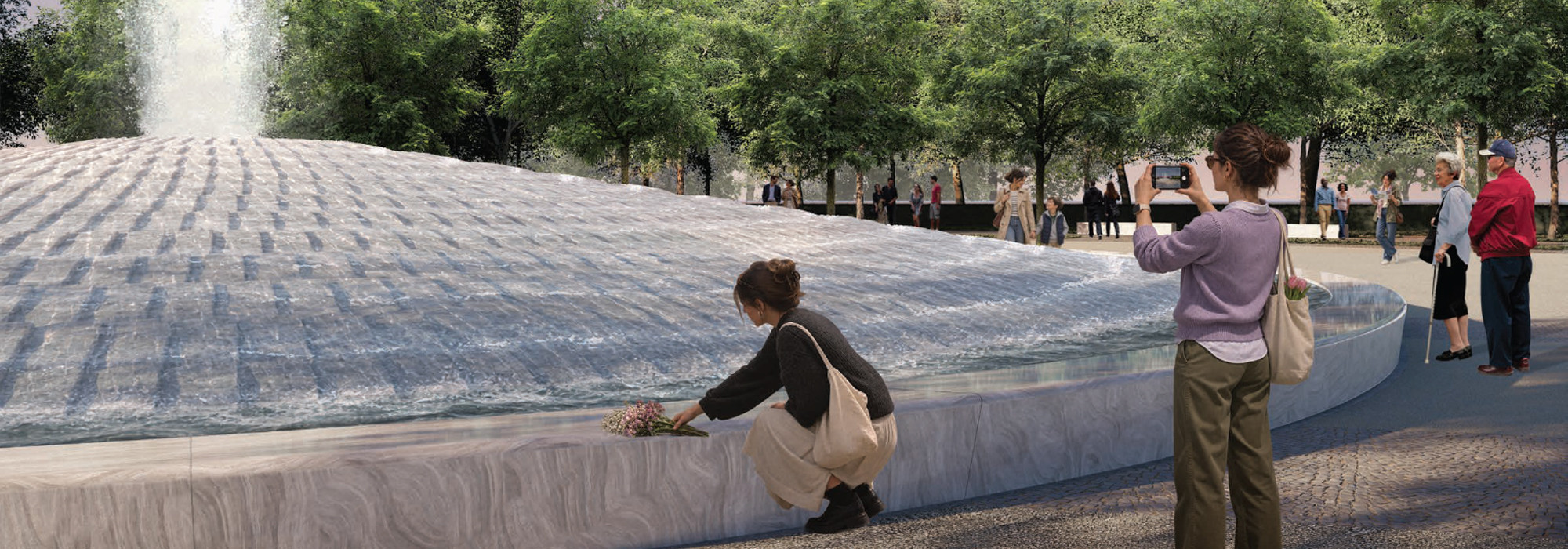
Washington, D.C. (November 17, 2026) – The Cultural Landscape Foundation (TCLF), a Washington, D.C.-based education and advocacy organization, today released a pair of design provocations developed by Jeremy Dvorak and Jake Geitner, landscape architecture students at the Harvard University Graduate School of Design, in collaboration with TCLF, as alternatives to a proposed 250-foot-tall Triumphal Arch in Memorial Circle in Washington, D.C. "Memorial Avenue: An Irreplaceable Axis of National Memory" provides two design provocations that rely on the reflective and contemplative quality of water to convey monumentality and commemoration. One design features a large circular reflecting pool and retains the site’s existing visual and spatial alignments and relationships, resulting in limited or no impact on vehicular circulation and no adverse effects to dozens of historic properties. The other honors the existing circle and reorganizes vehicular circulation along a central cobblestone axis, fortifying and reinforcing the connections between the end of Arlington Memorial Bridge and Memorial Avenue (and Arlington National Cemetery). The physical and visual connection invites people in, creating a contemplative gathering place in which to linger, and is flanked by two low-slung circular fountains. The new roadway can be flooded with a scrim of water for special occasions.
Why Provide Design Concepts Now?
The proposed 250-foot-tall Triumphal Arch has generated considerable controversy, yet during a legally required public review process the administration refused to consider any alternative sites, claiming, “relocation outside Memorial Circle would not fulfill the undertaking’s specific commemorative and location-dependent purpose.” These design provocations demonstrate how meaningful public involvement could yield commemorative concepts that honor Interior Secretary Doug Burgum’s stated rationale for the project “to reinforce the historic and ceremonial role of the Arlington Memorial Bridge and Memorial Avenue corridor as a symbolic gateway between Washington, D.C., and Arlington National Cemetery, while providing a new destination for public interpretation, reflection, and appreciation of the Nation’s history.”
However, rather than engage the public the administration terminated the reviews. And, as outlined below, this comes against the backdrop of legislation rapidly moving through Congress this week in the guise of permitting reform that would eviscerate Section 106 of the National Historic Preservation Act, which helps protect cultural landscapes and historic sites nationwide and guarantees public input.
The Arch is currently the subject of multiple lawsuits by veterans, the District of Columbia and Commonwealth of Virginia, and the County Board of Arlington County, Virginia, that say Congressional authorization is required and that the project violates the Height of Buildings Act, among other reasons. Moreover, public polling shows consistent majority opposition. Indeed, this past summer the National Park Service (NPS) received more than 107,000 comments during a federally mandated review process, nearly all opposed to the arch.
By law, specifically under Section 106 of the National Historic Preservation Act, the administration must determine if the project would have negative impacts (called “adverse effects”) on historic sites and how to “avoid, minimize, or mitigate” those negative impacts. Importantly, Section 106 requires public involvement noting: “public input is essential to federal decision making.” “Avoid” would include not building the Triumphal Arch or locating it elsewhere; “minimize” would include reducing the arch’s dimensions. The administration admits the Triumphal Arch will have negative impacts on dozens of adjacent historic sites that are listed in the National Register of Historic Places or as National Historic Landmarks. Most significantly, it would sever and permanently block the intended historic views between the Lincoln Memorial and Arlington House and Arlington National Cemetery, which represent the healing of the nation after the Civil War. It would also block views between the John F. Kennedy Gravesite and Eternal Flame and Arlington Memorial Bridge, and would cast shadows on the Kennedy site according to a lawsuit by Kennedy family members. The administration also claims the Arch would house drones, snipers, and ammunition, though plans for that have not been articulated including the perimeter hardening required to secure such a facility.
Rather than engage with the public, the administration shuttered the Section 106 review process saying they would not consider alterative designs or locations for the arch. Now, legislation touted as permitting reform that is rapidly moving Congress this week would eviscerate Section 106, effectively eliminating public input, and endangering neighborhoods, towns, cultural landscapes, Tribal lands, and historic sites throughout the country. It would also expedite the administration’s other controversial initiatives including a high-end golf course in East Potomac Park, a National Garden of American Heroes in West Potomac Park on the National Mall, and others.
Longstanding review authorities that have carefully and thoughtfully stewarded the evolution of Washington, D.C.’s Monumental Core—the U.S. Commission of Fine Arts (CFA) and the National Capital Planning Commission (NCPC)—are now stocked with administration appointees, many of whom lack essential qualifications in landscape architecture, architecture, civic planning, and public art. They have already uncritically acquiesced in voting to approve the new ballroom at the White House and the Triumphal Arch, and this Thursday, November 19, they could vote to approve the projects at East and West Potomac Parks, and permanent fencing around Lafayette Park—ground zero for First Amendment protected rights—across the street from the White House.
About “Memorial Avenue: An Irreplaceable Axis of National Memory”
According to the design team’s video presentation and illustrated written project narrative these design provocations extend from a 2026 seminar taught by Charles A. Birnbaum, TCLF’s Founding President & CEO, at the Harvard University Graduate School of Design: “As graduate students in landscape architecture, we took Birnbaum’s course to ground our emerging practices in critical historical inquiry and public participation. The current administration’s assertion of authority over national memory presented an opportunity to put these convictions into practice. After engaging with TCLF to develop a speculative counter proposal to the Trump administration’s contested plans for a triumphal arch at Memorial Circle, we began by applying the methods of historical inquiry introduced in Birnbaum’s course. At the outset of the design process, we found that the discourse surrounding the proposed Triumphal Arch was far more explicit in articulating its impacts on surrounding historic properties than in engaging Memorial Circle’s distinct history as a designed cultural landscape.”
As the designers note: “Taken individually, each proposal minimizes adverse effects on surrounding historic properties and restores the ceremonial procession between the National Mall, Arlington National Cemetery, and Arlington House by redistributing the existing memorial program across an open and reflective landscape. By recognizing Memorial Circle’s implicit expressions of monumentality, this pair of counter proposals asserts design’s capacity to critically engage history, accommodate public life, and advocate on behalf of our shared cultural landscape.”
As TCLF President, Charles A. Birnbaum notes: “Unlike the administration, we are listening to the public’s concerns—especially those of veterans and Gold Star families—and experts in the public, private and non-profit sectors who have advocated to protect one of the nation’s most solemn and symbolic cultural landscapes. These provocations, by design, illustrate that a solution that honors, embraces and works in collaboration with Memorial Circle’s historical and physical contexts is not only possible, but should be explored if this memorial is to truly commemorate the nation’s 250th anniversary.”
About the Design Team
Jeremy Dvorak is a landscape designer, educator, and researcher currently pursuing a Master of Landscape Architecture at the Harvard University Graduate School of Design. His work explores the intersection of landscape architecture, cultural history, representation, and material practice, with an emphasis on how design can reveal and reinterpret the relationships between people, infrastructure, and the built environment.
Jake Geitner is a landscape architecture student at the Harvard University Graduate School of Design. His academic pursuits combine cultural history with projective models of contemporary design research, developed further through research and teaching assistant positions within the Department of Landscape Architecture. As part of his ongoing thesis project, Jake is examining landscape as a stage for the negotiation of climate risk.
Charles A. Birnbaum is the Founding President & CEO of The Cultural Landscape Foundation.
About The Cultural Landscape Foundation
The Cultural Landscape Foundation (TCLF) is a 501(c)(3) non-profit founded in 1998 with a mission of “connecting people to places.” TCLF educates and engages the public to make our shared landscape heritage more visible, identify its value, and empower its stewards. Through its website, publishing, lectures, and other events, TCLF broadens support and understanding for cultural landscapes. TCLF is also home to the Cornelia Hahn Oberlander International Landscape Architecture Prize.
EDITORS: CLICK HERE FOR IMAGES AND VIDEO.
# # #