"A Slap in the Face to the Lincoln Memorial"
The sturm und drang over the administration’s proposed Triumphal Arch, National Garden of American Heroes, the White House ballroom, and many other changes to the nation’s capital has largely treated each project in isolation, which neglects the broader impact on one of the world’s most significant ensemble of historically designed landscapes—the Monumental Core, which stretches from the U.S. Capitol Grounds to Arlington National Cemetery, and includes the White House Grounds and the National Mall. And it ignores the key contributions over the span of many decades by one of the people who had the most impact on the capital since Pierre Charles L’Enfant in the late eighteenth century, the landscape architect Frederick Law Olmsted, Jr. It is vital to acknowledge and understand the nation’s capital as a supreme achievement in landscape architecture and planning if design decisions and alterations of any scale are to be assessed.
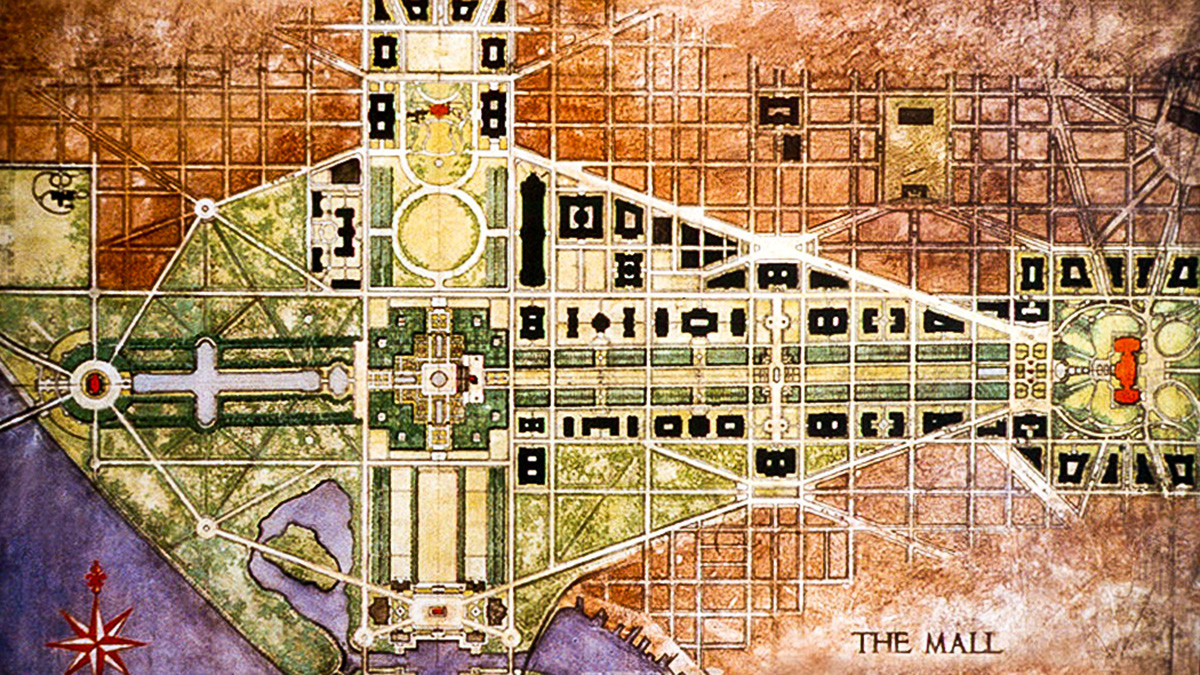
There are two critical points in Washington, D.C.’s landscape legacy—L’Enfant’s plan of 1791 and the McMillan Plan of 1902. L’Enfant’s baroque-inspired grand plan laid the city out on a primary grid with a series of diagonal streets radiating outwards and two seminal avenues. The McMillan Plan is the name given to the recommendations made in a report in 1902 by the Senate Park Commission for improving the design and appearance of Washington, D.C., particularly its historic core. The commission, formed in 1901, was chaired by Senator James McMillan of Michigan and included architects Daniel Burnham and Charles McKim, landscape architect Frederick Law Olmsted, Jr., sculptor Augustus Saint-Gaudens, and, acting as its secretary, Charles Moore. With the exception of McMillan and Moore, all had been involved to varying degrees in planning the World’s Columbian Exposition of 1893, which inaugurated the City Beautiful ideal in America, whose tenets are clearly expressed in the Commission’s report. It sought, in effect, to restore and amplify L’Enfant’s original plan for the city with the formal grandeur of an extended, cruciform National Mall, framed symmetrically by elms and punctuated by monumental neoclassical architecture in the Beaux-Arts manner, and terminating in what would become the Lincoln Memorial.
The L’Enfant/McMillan comprehensive vision has been the touchstone that has informed and guided the city’s design and has been stewarded by the U.S. Commission of Fine Arts (CFA), which was established by Congress in 1910 and is “the only federal commission dedicated to design review and aesthetic excellence.” The CFA’s influence on the Monumental Core has been singularly profound. The CFA is supposed to be “composed of seven presidentially appointed experts in relevant disciplines including art, architecture, landscape architecture, and urban design.”
Currently, it is largely bereft of that collective wisdom and notably devoid of any landscape architects.
Why does this matter? Former CFA Vice-Chair Elizabeth K. Meyer estimates that at least 80 percent of the projects that come before the commission involve landscape. In fact, since its earliest days, landscape architects have had a profound impact on major design decisions. The landscape architect on the inaugural commission of 1910 was Olmsted, Jr., who had previously been a member of the McMillan Commission; he remained a commissioner until 1918. He was the principal author of the Organic Act that created the National Park Service (which manages much of the city’s Monumental Core), a member of the National Capital Park Commission (1924-26), National Capital Parks and Planning Commission (1926-32), and the principal designer of the White House Grounds plan of 1935, which, until the recent proposal for a 90,000-square-foot ballroom, has guided work on those grounds for more than 90 years.
Consider Olmsted’s impact on the Lincoln Memorial and its grounds. As the inaugural Commissioner with expertise in landscape architecture "on the CFA and the only surviving member of the McMillan Commission,” according to the National Park Service’s Cultural Landscape Report (CLR) of 1999, “Olmsted exercised a unique influence over the development of the Lincoln Memorial grounds, serving as arbiter of design decisions regarding all aspects of the treatment of the landscape” [emphasis added]. The CLR also notes: “Throughout the design history of the Lincoln Memorial and West Potomac Park, various government organizations have had oversight in the areas of planning and design. In the early years of the development of the Lincoln Memorial, the Commission of Fine Arts had direct influence on all aspects of design in the memorial project. Layout, spatial relationships, planting, and site features were often conceived, shaped, and reviewed by the landscape architect member of the commission prior to approval by the full commission” [emphasis added]. The CFA’s website notes: "Olmsted Jr.’s work of many decades on the National Mall created a unified spatial composition from a sequence of disconnected landscapes."
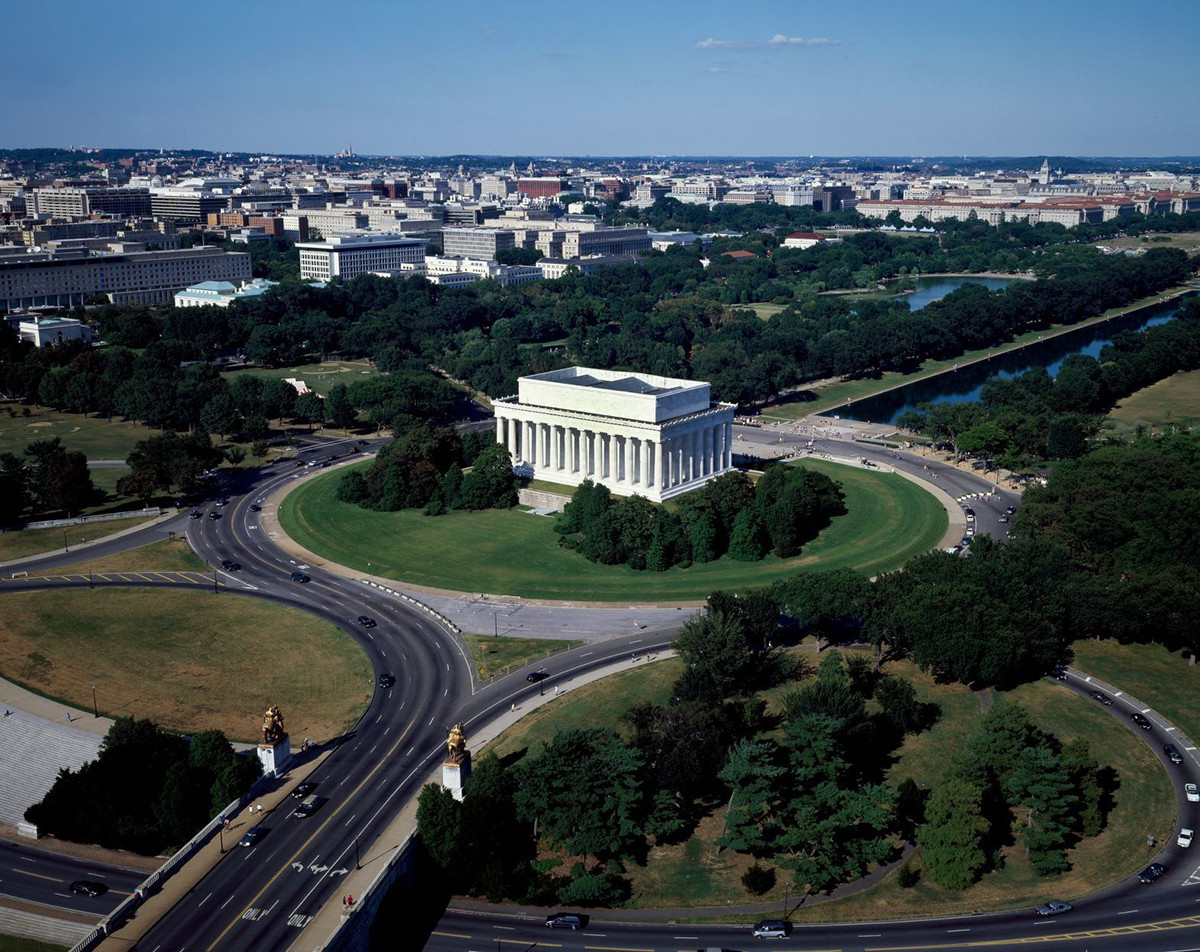
The Lincoln Memorial is a hinge point (on a bent axis) visually connecting the Washington Monument and the Reflecting Pool to the east, and Arlington House, southwest across the Potomac, which was built by George Washington Parke Custis, a grandson of Martha Washington, and intended to be a memorial to the first president. His daughter Mary Anna Randolph married Robert E. Lee in 1831 and she inherited the house in 1857 following her father’s death; the Lees abandoned the house in 1861 at the onset of the Civil War. Today the site is the national memorial to Robert E. Lee. The property overlooks Arlington National Cemetery.
Protecting the Lincoln Memorial’s Symbolism and its Integrity of Setting
Visually connecting the Lincoln Memorial to Arlington National Cemetery is Memorial Bridge, which opened in 1932, ten years after the Lincoln Memorial was dedicated, and is described in the National Register of Historic Places as “Washington's most beautiful bridge.” The idea for constructing the bridge had been considered on and off for decades. A design in 1886 by Paul Pelz “featured Renaissance Revival Towers and articulated steel arches crossing the Potomac River.”
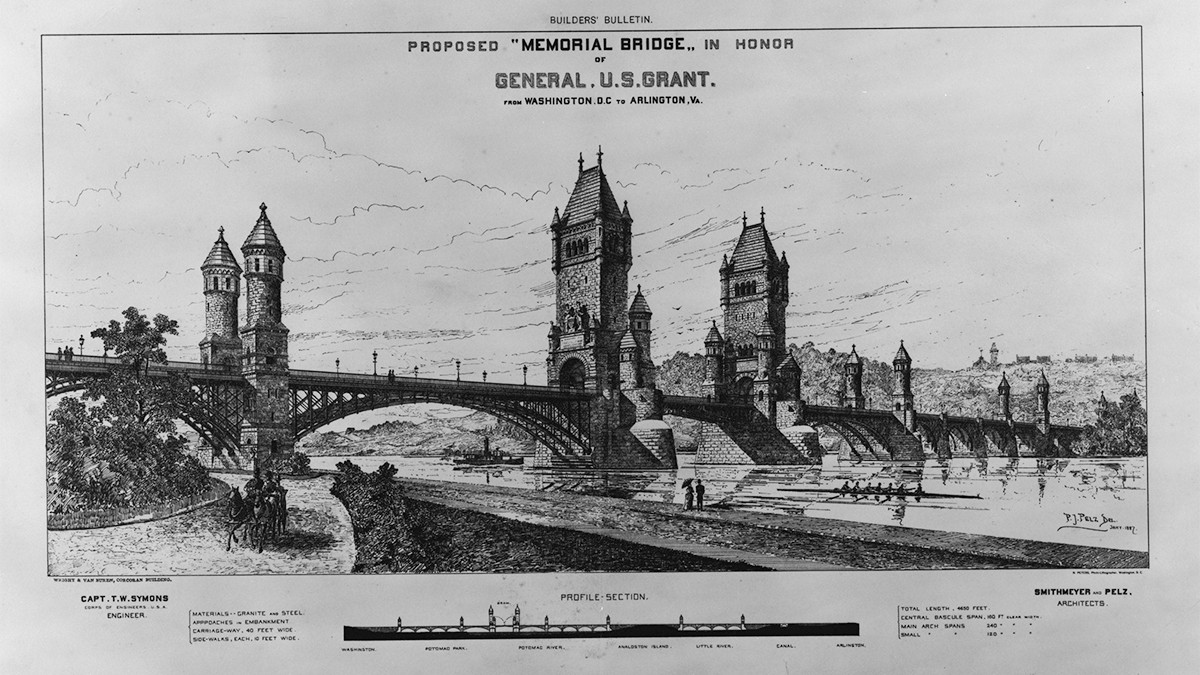
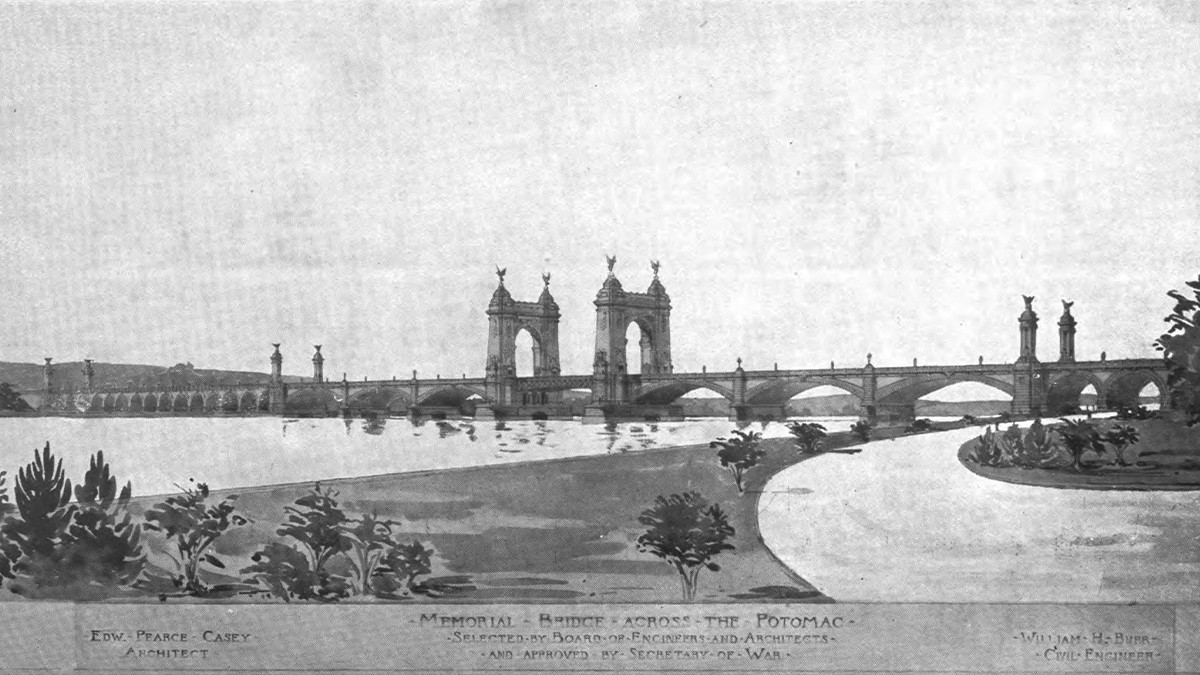
A design competition in 1899 yielded a winning entry by Edward Pearce Casey that included “Triumphal Arches on piers [that] emphasized an imperial architectural image” as noted in Civic Art: A Centennial History of the U.S. Commission of Fine Arts (p. 107). That design did not make it through the Senate. In 1900 architect George Keller had created a design that featured a monumental Romanesque Revival arch in a traffic circle on the D.C. side and a memorial column honoring the Union of the Virginia side.
According to the National Park Service the present bridge was “Symbolically … designed to show the strength of a united nation by joining a memorial on the north side of the Potomac River (the Lincoln Memorial) with one on the south (Arlington House, the Robert E. Lee Memorial).” It is the work of William Mitchell Kendall, a partner at the architectural firm McKim, Mead & White, who was brought on to design “the bridge and other features.” According to Civic Art (p.109), “Kendall envisioned an elaborate sculptural program … including seated figures of the first four American presidents on the D.C. side and reclining statues of oceans and river gods on Columbia Island. The bridge itself was to have forty allegorical statues.” That entire sculptural program was eliminated by the CFA, and some statuary and pylons were seen as too tall in relation to the memorial. Instead, there are two pairs of 40-foot-tall eagle-topped pylons on Columbia Island and two equestrian statues behind the Lincoln Memorial titled The Arts of War and The Arts of Peace.
The Historic American Engineering Record report of 1988 about Arlington Memorial Bridge by historian Elizabeth Nolin noted: “As the final link in the chain of monuments which start at the Capitol building, the Arlington Memorial Bridge connects the Mall in Washington, D.C. with Arlington National Cemetery in Virginia. Designed to connect, both physically and symbolically, the North and the South, this bridge, as designed in the Neoclassical style, complements the other monumental buildings in Washington such as the White House, the Lincoln Memorial, and the Jefferson Memorial.”
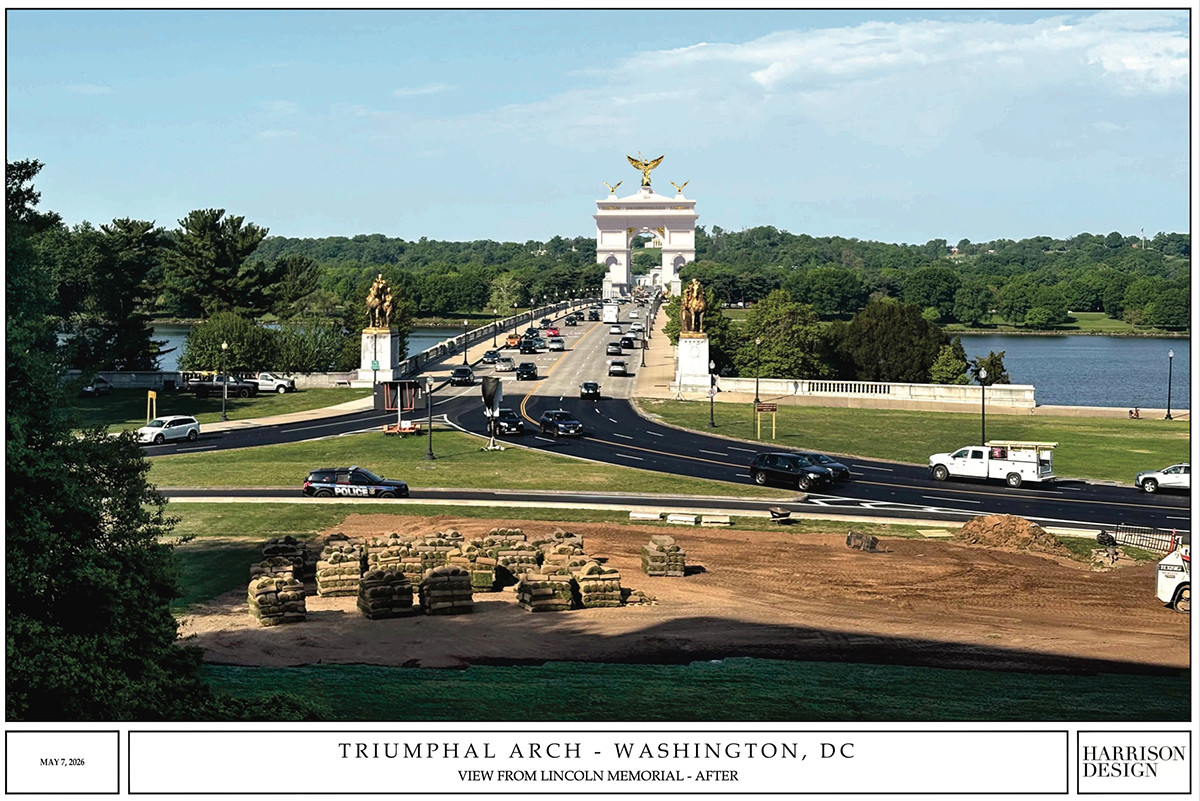
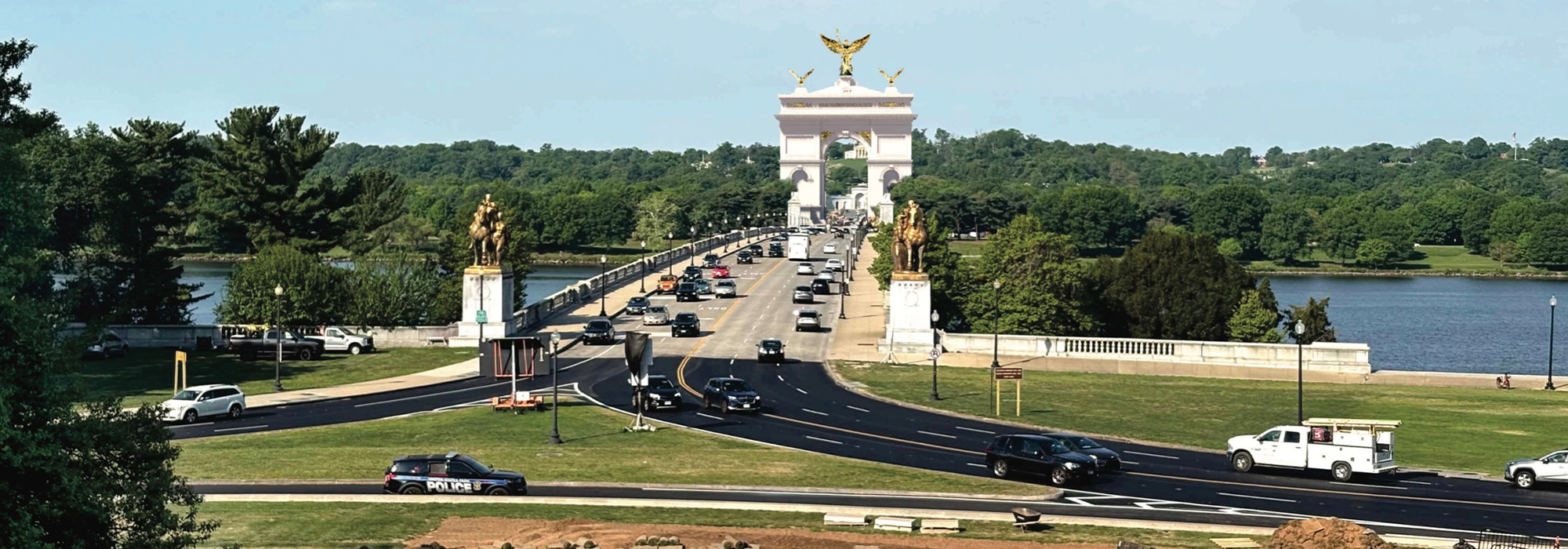
The proposed 250-foot-tall Triumphal Arch interrupts and severs key visual and spatial relationships that are integral to the Monumental Core’s design intent and its inherent symbolism, and which have been stewarded by the CFA for more than a century. The simulations submitted to the National Capital Planning Commission (above) in advance of that body’s June 4 meeting demonstrate the magnitude of the adverse effects, a result of the extreme and discordant heights and hierarchies created by the arch, that historic resources would be subject to, and show how the arch breaks with the purposeful design intent to unite North and South by building a visual obstacle between Arlington House and the Lincoln Memorial.
“A Slap in the Face”
Some 110 years ago, Olmsted, Jr. wrote a letter to Secretary of War Newton D. Baker concerning the proposed Memorial Bridge design; his sage observations are apt today: “The existing bridge design was the result of a competition held about 1899, before the Lincoln Memorial was even dreamed of…
“The bridge plans were carefully studied by members of the so-called Park Commission of 1900, of which I am the sole survivor. As a result of that study certain recommendations about them were made an essential part of our general plan. Among other things we said:
“Such modifications would call for the removal of the central ornamental towers, which would conflict with the proposed Lincoln Memorial.”
“These towers are the most conspicuous feature of the design and are so large and elaborate as to compete with the Lincoln Memorial not only in an artistic sense but in point of cost. To eliminate them from the design would involve its complete restudy as an artistic problem. Not to eliminate them would be like a slap in the face to the Lincoln Memorial and to the [McMillan] plan of which it forms a part" [emphasis added].
The same could be said of the current plans.
Related Content

Lincoln Memorial Grounds
Washington, DC
U.S. Capitol Grounds
Washington, DC
Arlington National Cemetery
Arlington, VA