


Design Provocations for Alternatives to a Triumphal Arch in Washington, D.C.
A 250-foot-tall Triumphal Arch proposed to be built on Memorial Circle in Washington, D.C. has generated considerable controversy because, as the administration admits, it would block historically significant views between the Lincoln Memorial and Arlington National Cemetery and Arlington House and negatively impact dozens of historic sites in Washington, D.C. and Virginia. However, during a legally required public review under Section 106 of the National Historic Preservation Act the administration refused to consider any alternative sites claiming, “relocation outside Memorial Circle would not fulfill the undertaking’s specific commemorative and location-dependent purpose.” Rather than engage the public on design solutions the administration terminated the reviews.
Jeremy Dvorak and Jake Geitner, landscape architecture students at the Harvard University Graduate School of Design, working in collaboration with The Cultural Landscape Foundation (TCLF), developed two design provocations to demonstrate how meaningful public involvement could yield commemorative concepts that honor Interior Secretary Doug Burgum’s stated rationale for the project “to reinforce the historic and ceremonial role of the Arlington Memorial Bridge and Memorial Avenue corridor as a symbolic gateway between Washington, D.C., and Arlington National Cemetery, while providing a new destination for public interpretation, reflection, and appreciation of the Nation’s history.”
This comes against the backdrop of legislation rapidly moving through Congress this week in the guise of "permitting reform" that would eviscerate Section 106, which helps protect cultural landscapes and historic sites nationwide and guarantees public input. A national coalition of more than 1,200 organizations is mobilized to protect Section 106 and they need your help today.
Below is an illustrated narrative provided by Dvorak and Geitner along with a video in which they discuss their research-based design process.
Memorial Avenue: An Irreplaceable Axis of National Memory
by Jeremy Devorak and Jake Geitner
Prompted by the current administration’s proposal for a Triumphal Arch at Memorial Circle, this initiative speculates on alternate futures for the site. The effort embraces design as a critical act, offering two proposals with varied treatment to the site’s location on Memorial Avenue’s historic processional axis.
The opening proposal offers a restrained departure from the existing conditions, reflecting messages of hope and unity across the circle’s existing traffic pattern toward its monumental anchors. As an ambitious alternative, an accompanying proposal elevates the site as a distinct moment for contemplation and gathering along Memorial Avenue. Whereas the former implicitly acknowledges the complexities beget by monumental plans for the circle, the latter foregrounds the site as a landscape for remembrance. Developed through a collaboration between Jeremy Dvorak, Jake Geitner, and The Cultural Landscape Foundation (TCLF), these counter proposals source from Columbia Island’s rich history as a designed landscape.
Rather than invoking the site’s lineage of practitioners as the basis for intervention, the project reappropriates formal and experiential qualities from past design iterations to recover Memorial Avenue as an irreplaceable axis of national memory. Taken individually, each proposal minimizes adverse effects on surrounding historic properties and restores the ceremonial procession between the National Mall, Arlington National Cemetery, and Arlington House by redistributing the existing memorial program across an open and reflective landscape. By recognizing Memorial Circle’s implicit expressions of monumentality, this pair of counter proposals asserts design’s capacity to critically engage history, accommodate public life, and advocate on behalf of our shared cultural landscape.
Narrative
This effort extends from the class taught by Charles Birnbaum (President and CEO, TCLF) at the Harvard University Graduate School of Design. As graduate students in landscape architecture, we took Birnbaum’s course to ground our emerging practices in critical historical inquiry and public participation. The current administration’s assertion of authority over national memory presented an opportunity to put these convictions into practice. After engaging with TCLF to develop a speculative counter proposal to the Trump administration’s contested plans for a Triumphal Arch at Memorial Circle, we began by applying the methods of historical inquiry introduced in Birnbaum’s course. At the outset of the design process, we found that the discourse surrounding the proposed Triumphal Arch was far more explicit in articulating its impacts on surrounding historic properties than in engaging Memorial Circle’s distinct history as a designed cultural landscape. Rather than reiterating the well-documented impacts that the arch would have on the site’s historic axes, we pursued an investigation into the particularities of Memorial Circle’s relationship to these broader connections. Our attention turned early to a narrow band of cobble paving extending toward Memorial Circle from Arlington National Cemetery’s Military Women’s Memorial. Although it may seem trivial to measure an eighteen-inch strip of cobble paving against looming plans for a 250-foot-tall monument, this seemingly minor detail provided a framework through which we could begin to critically investigate Memorial Circle’s history. Our research ranged from the well-trodden territory of the early twentieth-century McMillan Plan to lesser-known midcentury interventions realized through a collaboration between Lady Bird Johnson and Edward D. Stone and Associates. More than simply helping us attribute the cobble paving to Memorial Drive’s historic funerary processions, these precedents illuminated the principle by which Charles Moore—a founding member of the United States Commission of Fine Arts and its chairman from 1915 to 1937—advocated for the site to be approached as a “constituent part of one large composition.” Drawing upon this layered history, we translated the site’s historic formal and experiential qualities into a design language that recovered its associations with processional acts of unity and remembrance. As a year of national celebration comes to a close, these speculative proposals argue for designers, and the public alike, to reorient conventional narratives around monumentality toward a recognition and care for the cultural history embedded in our shared landscapes.
Provocation / Context
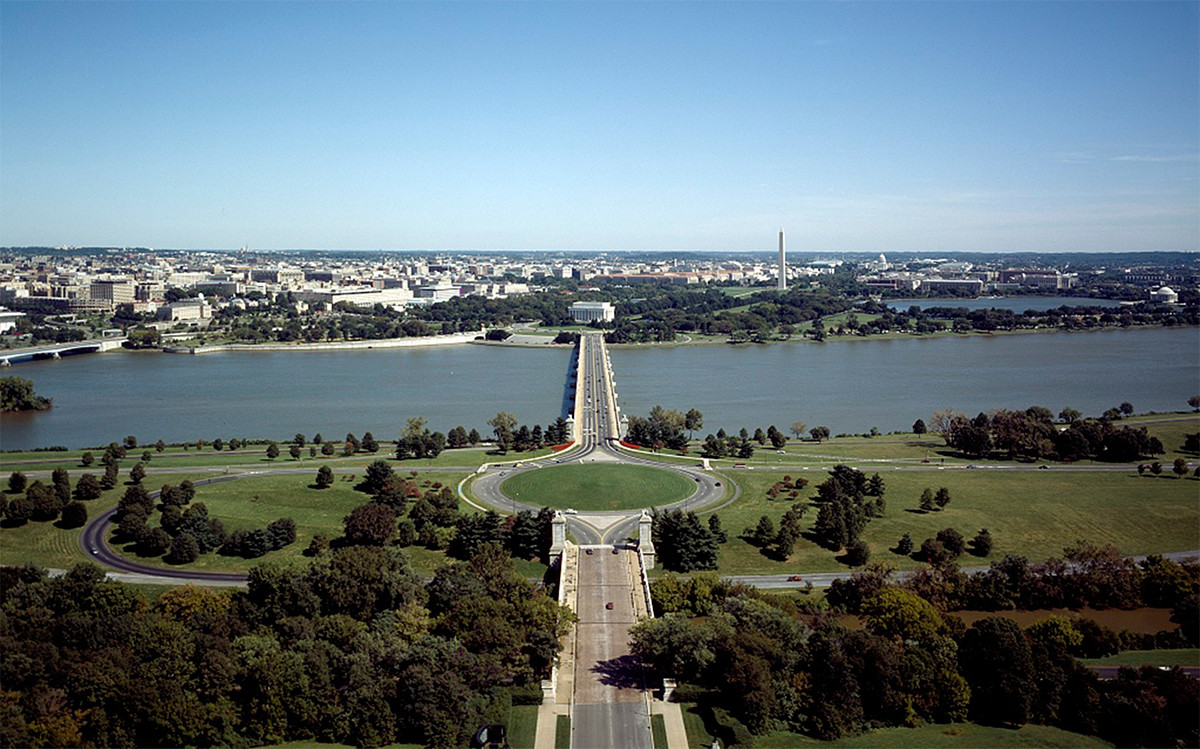
Between Lincoln Memorial, Arlington National Cemetery, and Arlington House lies Memorial Circle, a landscape marked by the movement of vehicles more than the monuments it bridges. Situated at the western terminus of Arlington Memorial Bridge, Memorial Circle occupies a significant position in Washington’s monument landscape.
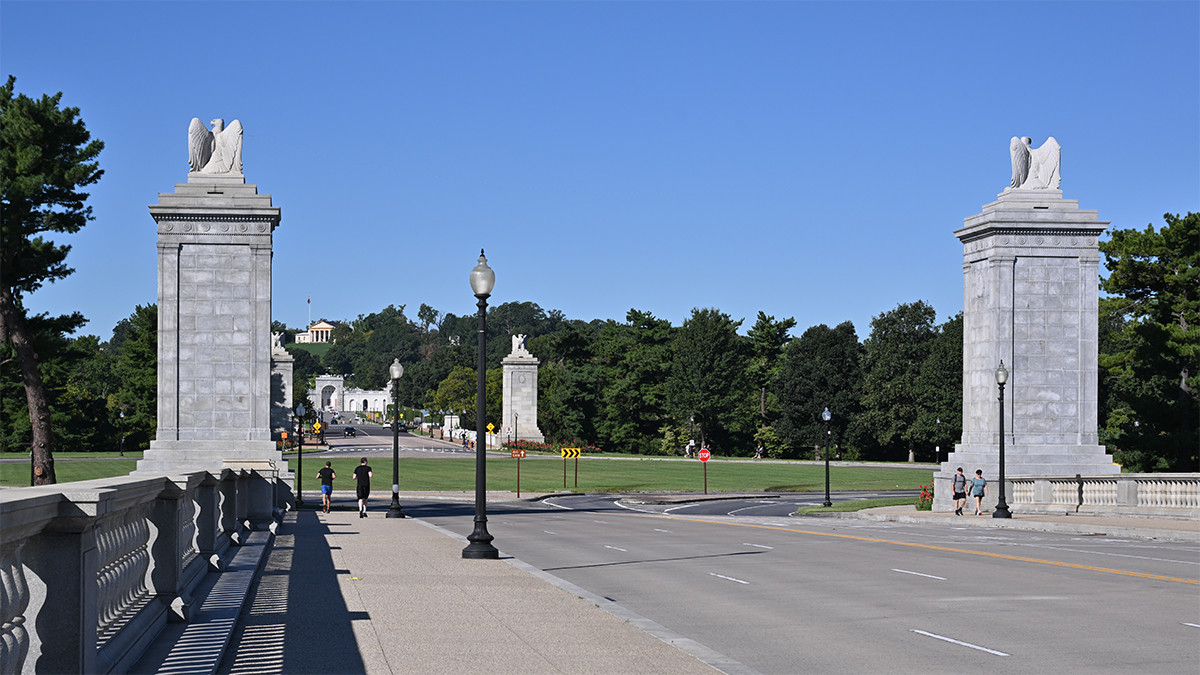
Despite this location, the space remains largely inaccessible to the public. Visitors, tourists, and locals alike, pass through it, around it, and alongside it, but cannot occupy it. What was once conceived as a monumental composition has become more of an isolated traffic circle than a memorial expression. The commemorative agenda sponsored by the nation’s semiquincentennial has brought renewed attention to the site. Namely, the proposed Triumphal Arch has been introduced as a novel architectural landmark at Memorial Circle. Such a proposal raises broader questions about the nature of commemoration in the nation’s capital: must monumentality be expressed through construction of another object, or might it already exist within Washington’s cultural landscape? In response to the questions looming over the current administration’s plans, this proposal speculates on alternatives for the site. The proposal interrogates the role of monument, carefully reconsidering the ground on which Memorial Circle stands. Drawing from more than a century of unrealized plans, it imagines Memorial Circle as a continuous public landscape where history, ceremony, and everyday life might establish a different understanding of monumentality. Engaging with this history requires more than selectively recovering unrealized designs; it demands an understanding of why certain proposals were advanced, altered, or rejected, and embracing the political, cultural, and infrastructural complexities that challenge the landscape as it exists today.
Some Histories
The idea of a ceremonial connection between Washington and Arlington predates Memorial Circle, and even Columbia Island itself. In 1901, McMillan Commission envisioned a monumental framework that extended the capital’s formal composition beyond the National Mall. The McMillan Plan ultimately established the foundation for the processional landscape that connects Lincoln Memorial across the Potomac River to Arlington National Cemetery and Arlington House (below, left).
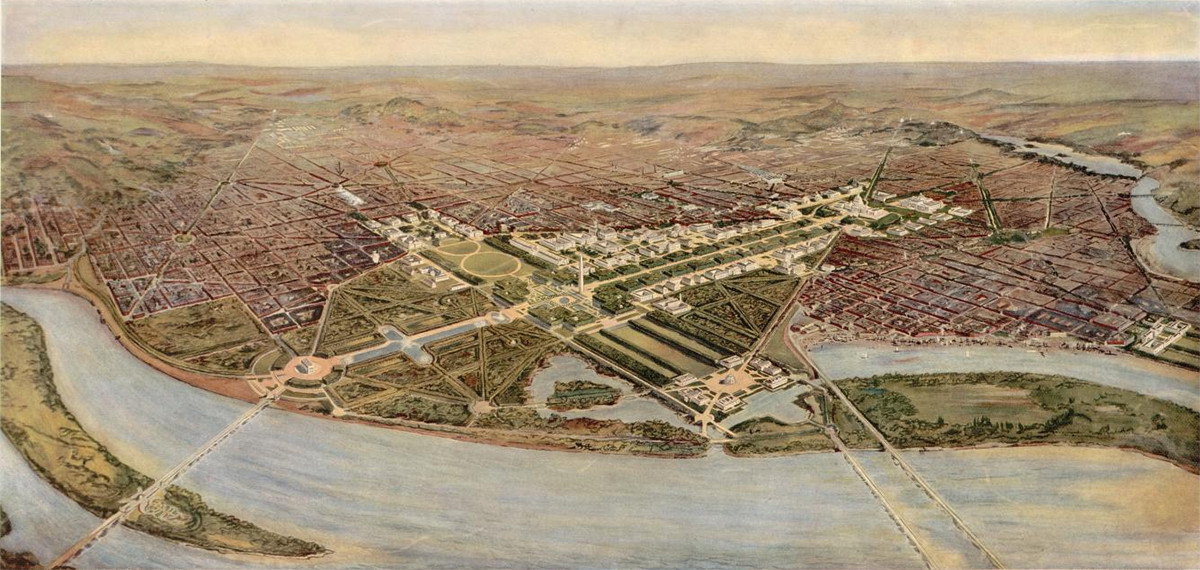
As this landscape came to be constructed, architects and landscape architects imagined several proposals on the island. These designs varied from elaborate compositions of circular plazas, monumental columns, geometrics gardens, and fountains. Despite their varied form, these precedents demonstrated an understanding of Memorial Circle as a feature of Washington’s larger ceremonial composition. Charles Moore, chairman of the Commission of Fine Arts, emphasized the importance of this compositional understanding, warning against its reduction to a “mere thoroughfare.” Moore’s wisdom was prescient, the construction of the roundabout, in 1940, spatially rearranged the site, where the surrounding landscape assumed a secondary role, becoming a residual space between roadways rather than the subject of the design. The irony of Memorial Circle’s central position on one of the nation’s most important axes, but less than central to the experience of said axes is the starting point for this proposal. The project looks to balance the site’s spatial legibility with its geographic monumentality. Further, the designs employ the site’s unrealized proposals as an archive of alternative possibilities—evidence that Memorial Circle’s existing conditions, and pending proposals, are neither inevitable or the only possible future.
In August of 2025, Trump’s executive order, Making Federal Architecture Beautiful Again, explicitly identified Charles F. McKim among other practitioners associate with classical architecture. McKim was among the many who had proposed designs for Memorial Circle. The order writes that federal buildings should, where possible, permit a generous development of landscape. The juxtaposition between the McMillan plan’s monumental interpretation of landscape, and Trump’s executive order—which mentions landscape once, as decorative— demands a reconsideration of landscape’s role within the White House’s design agenda. Working through varied form and materiality, this effort suggests at how cultural landscapes might perform at monumental scales. The project intends to think through monumentality in a contemporary context, while also honoring the cultural landscape in which it is situated. The approach shifts attention from object to experience, aesthetics to relationships, action to acting, and individuals to collectives.
The Proposals
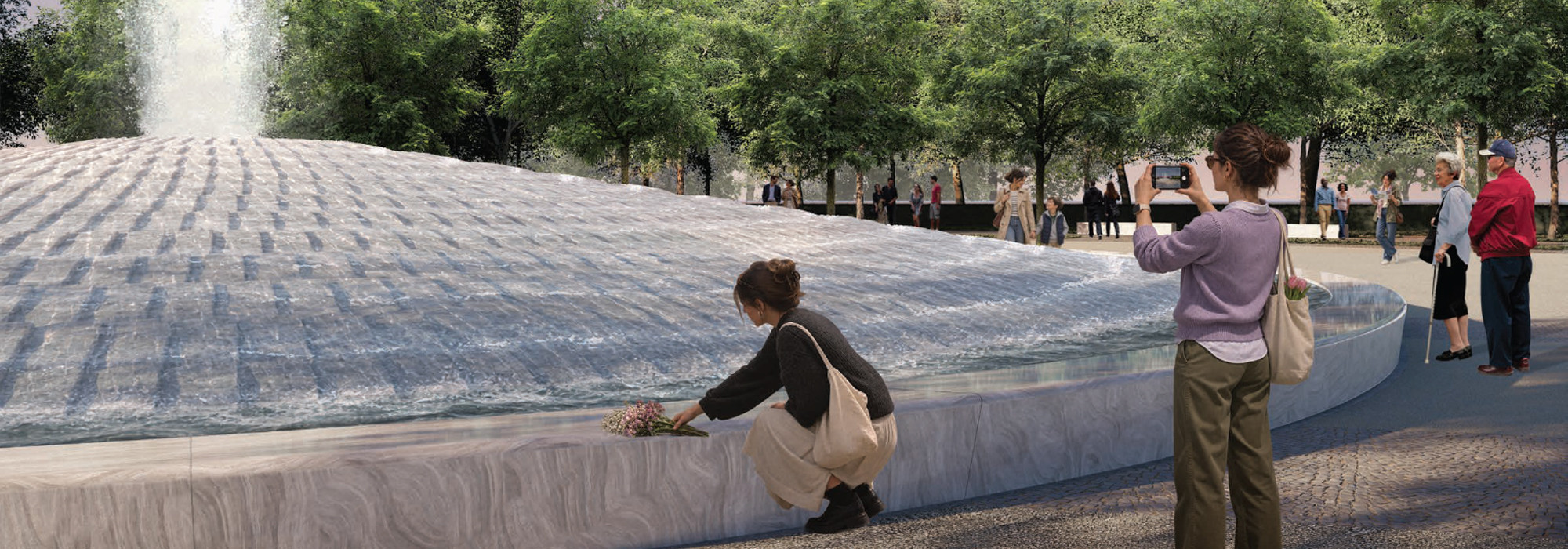
The opening proposal takes a critical position on Memorial Circle as a void along the historic axis between Washington and Arlington. Rather than occupying the site with a piece of monumental architecture, the design inhabits the inner circle with an expansive sheet of water that reflects across the existing traffic pattern toward Lincoln Memorial, Arlington National Cemetery, and Arlington House.
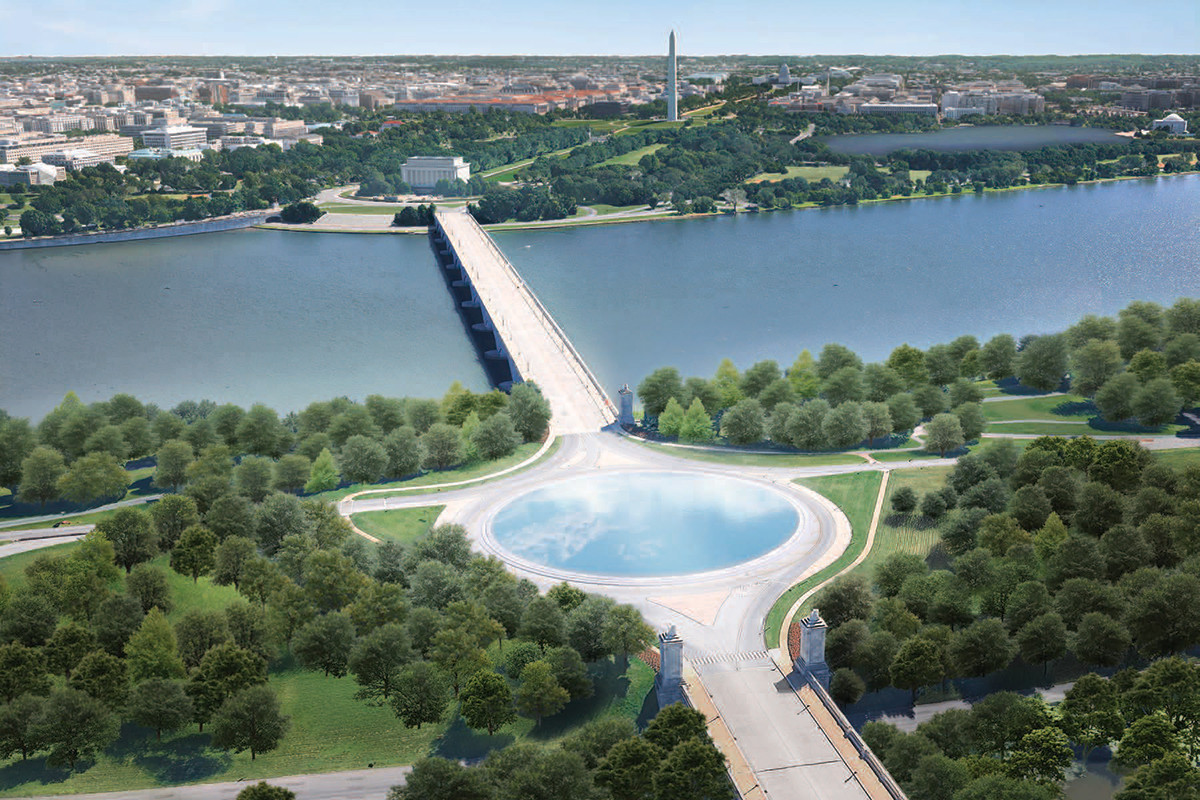
To both preserve the historic viewshed along Memorial Avenue and maximize the water’s reflective properties, the pool sits at a deliberately low elevation relative to the surrounding landscape. Primarily experienced from a vehicular perspective, the proposal is equally animated by the circle’s dynamic urban patterns and its natural environment. Formed in a natural stone representative of the surrounding site features and Washington’s broader monument landscape, the reflective pool is enclosed in a sweeping granite profile inscribed with words of belonging and unity. With its restrained occupation of Memorial Circle, the proposal symbolizes landscape’s capacity for an outward reflection on the nation’s history.

In contrast, the second proposal begins with the removal of the existing roundabout and the reorganization of vehicular circulation. By restoring the east-west ceremonial axis and redistributing intersecting traffic to the edges of the site, a continuous pedestrian landscape can emerge between Arlington Memorial Bridge and Memorial Avenue. Not only does this create a simpler and safer traffic flow, it allows one to physically inhabit the processional ground. Two monumental fountain landscapes occupy the areas north and south of the central axis.
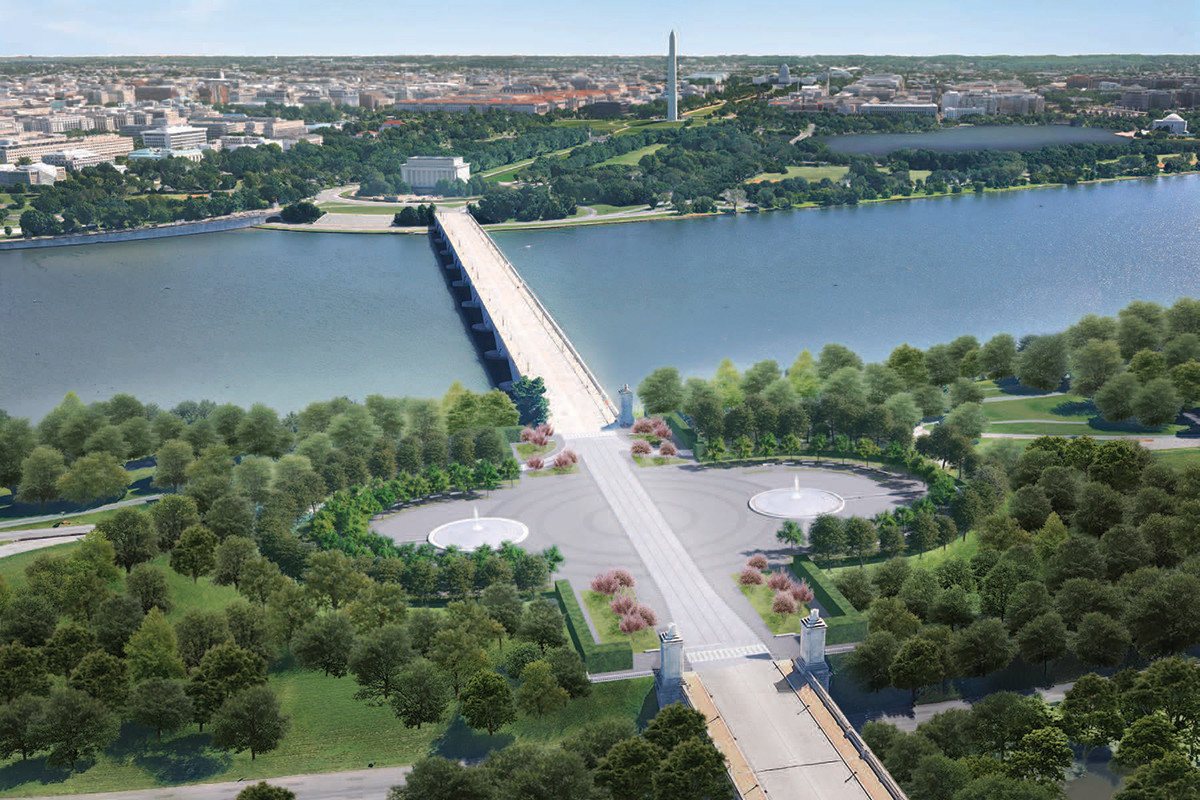
Their geometries arise from the site’s historic proposals, combining concentric circles, intersecting alignments, and formal planting into a composition that acknowledges history whilst creating its own present identity. In this way the landscape becomes a physical record of its own change. Histories and plans that remain confined to archival drawings become legible through the experience of physically moving across the site. Water is central to the design, two of the fountains draw on the site’s previously approved plan for two “large fountain pools with low coping and high perpetual sprays of water, placed in the center of circles having a diameter of 200 feet.” Another fountain appears during commemorative events, like the annual 4th of July celebration or presidential funeral processions, to transform the space without the construction of additional monuments. The ground itself, through a reflective scrim, is capable of assuming different spatial identities.
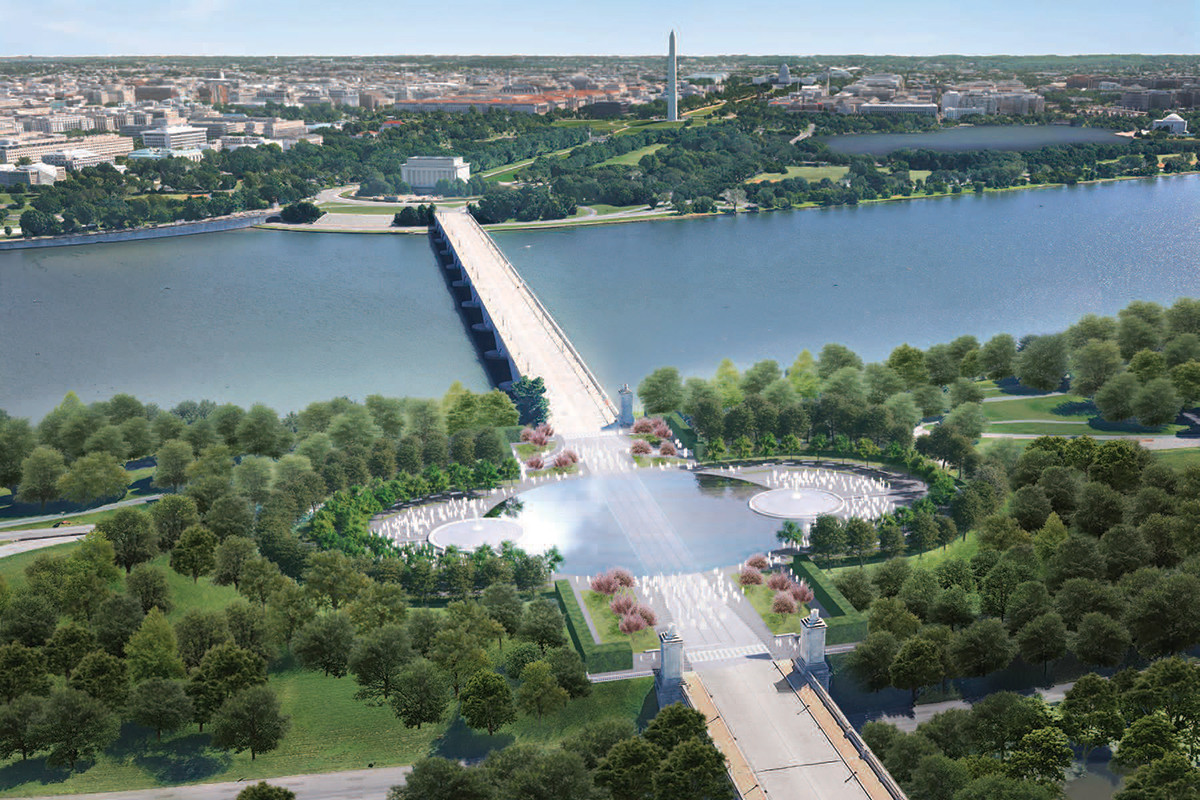
The variability challenges the notion of monument as fixed and permanent expressions of memory. While stone is a physical and durable framework, it is the water, and its states of turbulence or tautness that stage new relationships with this important landscape. Furthermore, these fountains are enclosed through the introduction of a formal hedgerow and tree planting, which modulates the sites geographic importance to the intimate scale of a visitor.
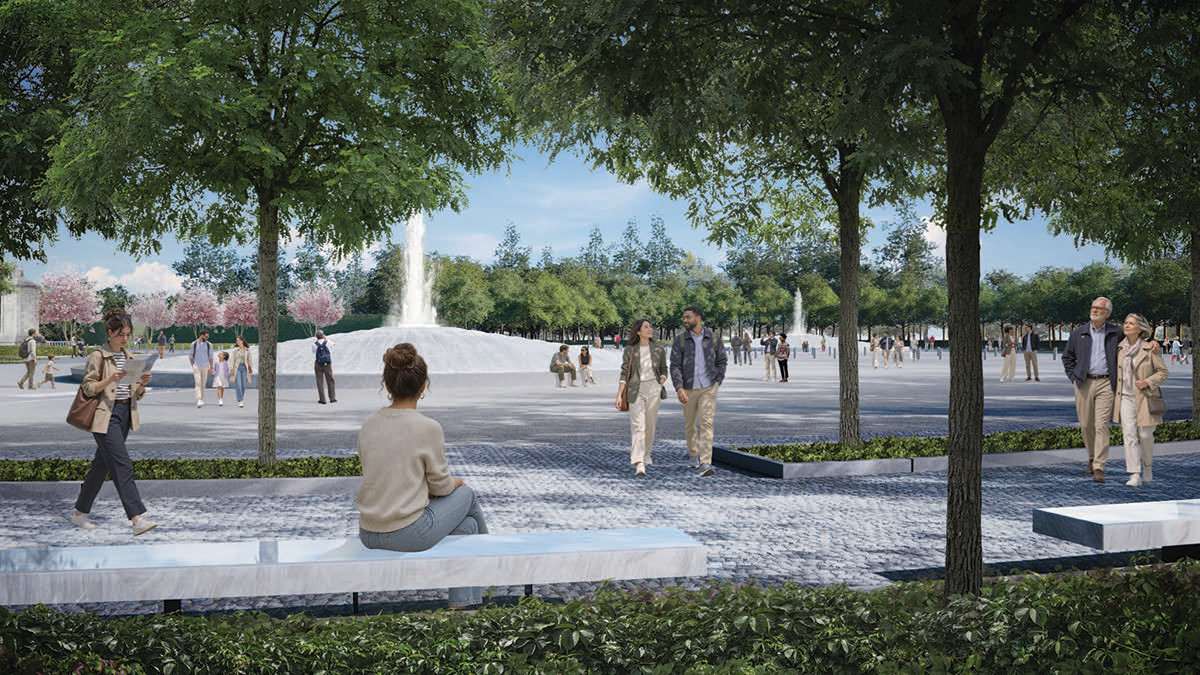
Memorial Circle’s relationship to Arlington National Cemetery remains important, where funeral processions, national commemorations, and individual acts of remembrance have imbued the route with significance far greater than its function as a road. On the other hand, the site is also common to joggers, tourists, and others alike. These activities do not diminish the significance of the site, but instead sustain its monumentality through everyday use. The presence of public life allows the landscape to remain culturally relevant and connected to the people it represents. Consequently, the monument is not understood through a single event, but its meaning is registered across repeated encounters, across seasons, and through different forms of occupation.
Ultimately, these design provocations are not intended as definitive directions for Memorial Circle. Instead, these alternate futures provide an opportunity to think differently about landscape architecture, cultural history, and memory alongside national representation. Simply on the basis of its presentation as open space, must it be inevitable that the existing roundabout is occupied by a monumental work of architecture? Or might smaller, but no less significant, acts of procession—or even the simple placement of flowers—meaningfully express national remembrance? Perhaps monumentality does not reside in an object at all, but in the landscape that makes these acts possible.
Biographies
Jeremy Dvorak is a landscape designer, educator, and researcher currently pursuing a Master of Landscape Architecture at the Harvard Graduate School of Design. His work explores the intersection of landscape architecture, cultural history, representation, and material practice, with an emphasis on how design can reveal and reinterpret the relationships between people, infrastructure, and the built environment.
Prior to Harvard, Jeremy spent six years at SWA Group in San Francisco, contributing to public realm, institutional, and large-scale landscape projects across the United States and internationally. His professional experience encompasses conceptual design, site planning, landscape documentation, and the integration of complex cultural and environmental conditions into public spaces.
At Harvard, he has served as a studio instructor and teaching assistant and is a graduate student associate at the Davis Center for Russian and Eurasian Studies. His research examines the role of drawing, modeling, and material experimentation in interpreting landscapes and their histories.
His approach to landscape architecture brings together historical inquiry, technical design, and spatial storytelling to create meaningful public environments. He is particularly interested in landscapes of collective memory, civic identity, and commemoration, and in the capacity of design to make historical narratives legible through contemporary spatial experiences.
Jake Geitner is a landscape architecture student at the Harvard University Graduate School of Design. His academic pursuits combine cultural history with projective models of contemporary design research, developed further through research and teaching assistant positions within the Department of Landscape Architecture. As part of his ongoing thesis project, Jake is examining landscape as a stage for the negotiation of climate risk.
Prior to pursuing his graduate degree, Jake practiced with the landscape architecture and planning firm Studio-MLA in Los Angeles, where his work was driven by participatory design processes and novel models for community-based stewardship. He contributed to a range of public-facing projects including Puente Hills Regional Park, Los Angeles International Airport, and the San Gabriel Valley Greenway Network Strategic Implementation Plan. Parallel to his project work, Jake led the studio’s collaboration with Los Angeles County on a design discovery program for high school students from historically marginalized communities.
Jake holds an undergraduate degree in landscape architecture from Cornell University, where he was recognized as an Olmsted Scholar and Upstate New York ASLA Distinguished Student. His work is committed to the histories and near futures of American urbanization, a pursuit he closely aligns with his passion for photography.
Related Content
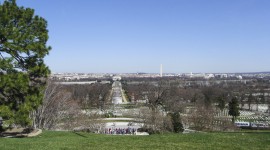
Arlington National Cemetery
Arlington, VA
Lincoln Memorial Grounds
Washington, DC
