At Risk: Dallas City Hall
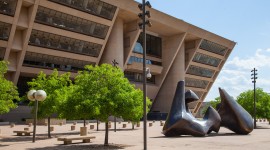
Dallas City Hall is an exceptional melding of Modernist landscape architecture and a Brutalist building. Completed in the late 1970s, it comprises a public plaza by Dallas-based landscape architects Myrick, Newberg, Dahlberg and Partners and a building by architects I.M. Pei & Partners. It was conceived as part of the effort to rebuild the city’s image after the assassination of President John F. Kennedy at Dealey Plaza in 1963.
After years of deferred maintenance, the plaza and building need extensive repairs. Following months of debate, the Dallas City Council voted to explore relocating City Hall to a different downtown site. Such a move would likely result in the existing building being razed and the park redesigned.
History
After the assassination of President Kennedy, Mayor J. Erick Jonsson sought to redefine the city. Inspired by the design of Copenhagen’s City Hall in Denmark, Jonsson envisioned a municipal building complemented by a civic plaza and assembled a committee to select a site. The committee chose a downtown parcel with views of the neighborhood’s high-rise buildings. Jonsson praised the site as “exceptional,” adding, “we should never settle for anything humdrum. Let us try for something truly beautiful and imaginative.” In 1966 I.M. Pei of I. M. Pei & Partners was selected to design the building (two years earlier Pei was commissioned to design the John F. Kennedy Presidential Library and Museum in Boston). One year later the city acquired a contiguous parcel for a public plaza and underground parking garage.
I.M. Pei & Partners designed a cantilevered structure, completed in 1977, adjacent to an underground parking garage. Atop the garage at ground level, local landscape architecture firm Myrick, Newberg, Dahlberg and Partners designed the approximately five-acre plaza.
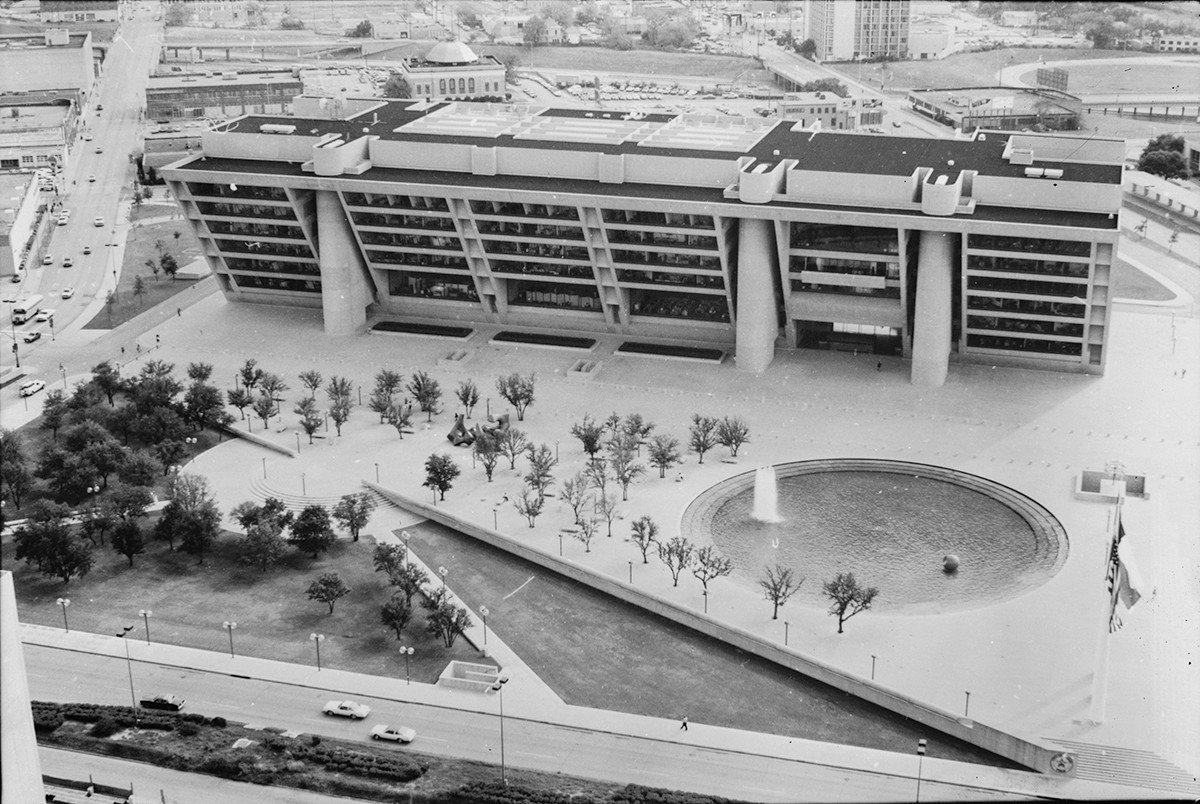
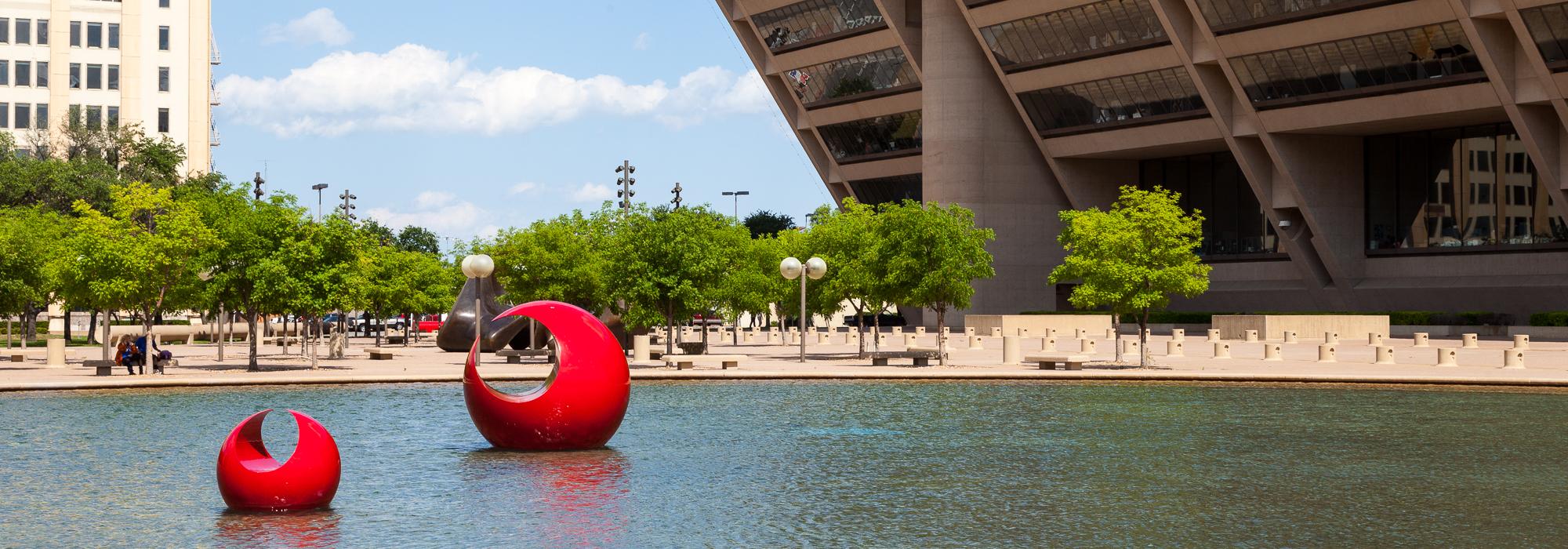
Fronting the cantilevered façade of the city hall, the rectilinear plaza is cut diagonally by a low concrete wall and features two triangular sections connected by arcing steps. The northeast section includes a relatively level lawn planted with a bosque of live oaks whereas the southwest portion comprises a raised concrete plinth. The centerpiece of the buff-colored concrete plinth is an 180-foot diameter circular reflecting pool punctuated by two floating red spherical sculptures (1973) by artist Marta Pan that spin when activated by the wind. The plaza also features a three-piece bronze sculpture, The Dallas Piece, by Henry Moore, commissioned for the site in 1978.
Designed concurrently, the building and plaza possess a high degree of integrity, having been minimally altered since their construction. Over the years the plaza has become an important public gathering space hosting festivals, parades, protests, and more.
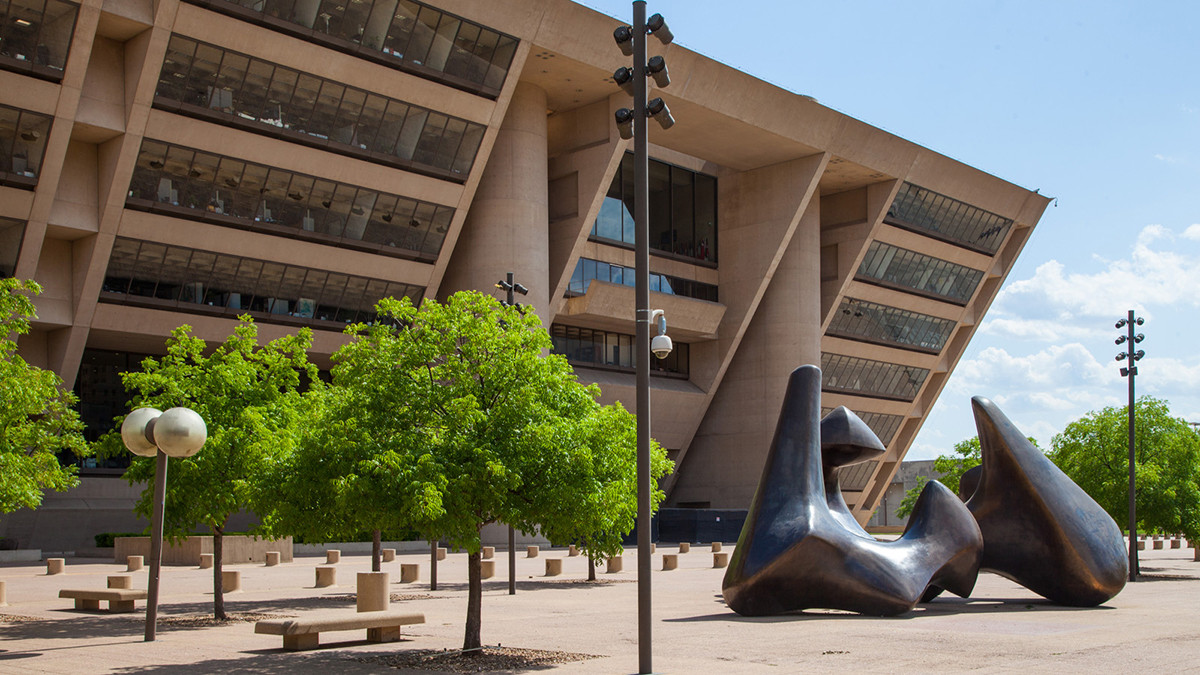
Dallas City Hall was recently recognized by the World Monument Fund’s (WMF) Irreplaceable America initiative in commemoration of the 250th anniversary of the signing of the U.S. Declaration of Independence. The report spotlights ten sites—selected by a six-person, expert panel (including TCLF President and CEO, Charles A. Birnbaum)—that “reflect the breadth of the American experience and demonstrate how heritage can shape the nation’s future.” The WMF lauds Dallas City Hall as “one of the most significant examples of brutalist civic architecture in the United States,” emphasizing that the building was “designed in dialogue with its entrance plaza.” Together they “represented a new era in the design of civic buildings that focused on participation in city government and providing space for public assembly.”
Threat
In November 2025, Dallas City Council voted to explore options for relocating City Hall operations and potentially redeveloping the City Hall site. As part of the vote, they requested a report on the cost of repairing versus moving to another building downtown. AECOM prepared a report, estimating it would cost $1.14 billion over the next twenty years to address deferred maintenance and to fully modernize and operate Dallas City Hall. Advocates for rehabilitation, including the organization Save Dallas City Hall, have rebuked this estimate. They argue that, according to a careful analysis of the report, the actual cost will be closer to $153 million.
Several developers and organizations contend that relocating City Hall would allow redevelopment of the fifteen-acre site, including its plaza and parking. They claim that this action is necessary to revitalize downtown, which like many downtowns since COVID, face high vacancy rates. The NBA team, the Dallas Mavericks, expressed interest in the site, but as of late May, they are exploring alternate options and no longer appear interested. Nonetheless, in June, the City Council voted 9 to 6 to not repair Dallas City and to explore options for a new site.
Since the plaza is a voter-funded public park, according to state law, it cannot be sold, unless authorized by a public referendum. This means that if the city abandons the building, it is possible that the plaza will remain a public space. However, in this scenario it is also likely that the park would be redesigned. Regardless, even if the park remains unaltered, any changes to the building will negatively impact the park and the integrity of its setting. The building and plaza were designed in tandem and are irrevocably connected—they are defining features of a cohesive whole, not separate entities that can be modified in isolation.
What You Can Do to Help
In June, the City Council approved engaging outside consultants to solicit four options for the relocation of City Hall to an existing downtown building. Those options will go to the City Council in late August for them to weigh the cost of staying and rehabilitating, versus moving to another location. TCLF encourages members of the public to contact Dallas Mayor Eric L. Johnson and City Council members, urging them to rehabilitate Dallas City Hall, including its Modernist plaza.
Mayor, Eric L. Johnson and Dallas City Council
1500 Marilla Street, 5th Floor
Dallas, Texas 75201-6390
P: 214-670-4050
E: To contact Mayor Johnson and City Council via email, use the online forms provided by the city or by Save Dallas City Hall.
The public is also encouraged to donate to the Save Dallas City Hall campaign. Donate here.