Landscape Information
Measuring 6.5-acres, this rectangular property was one of the first publicly owned historic sites in the country. Sloping toward the Hudson River’s western shore, barely a quarter mile away, the site’s western perimeter is marked by a Victorian-era, cast-iron fence. Along Colden Street, to the east, is a rough-cut fieldstone wall, whereas along Washington Street, to the north, is an angled, diamond-cobbled wall pierced by oval openings.
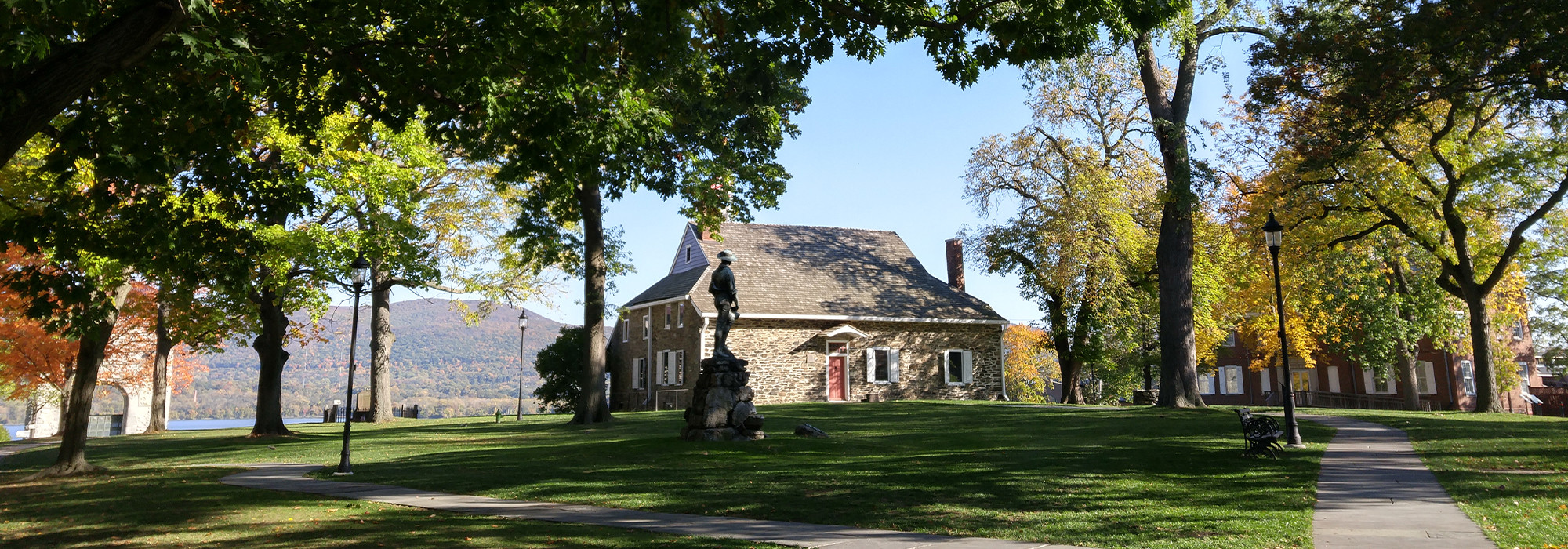
Centrally located on a bluff, commanding high-elevation views of the river and Hudson Highlands, the site’s oldest structure was built by Colonel Jonathan Hasbrouck in 1750 with two later additions (1750–1770). The French-Huguenot and Dutch-vernacular fieldstone farmhouse provided an advantageous location for General George Washington’s operations, 1782 to 1783. Here, he drafted significant national documents, including one rejecting the notion of a monarchy. After his departure, the Hasbrouck family returned until it was sold to the State of New York in 1850.
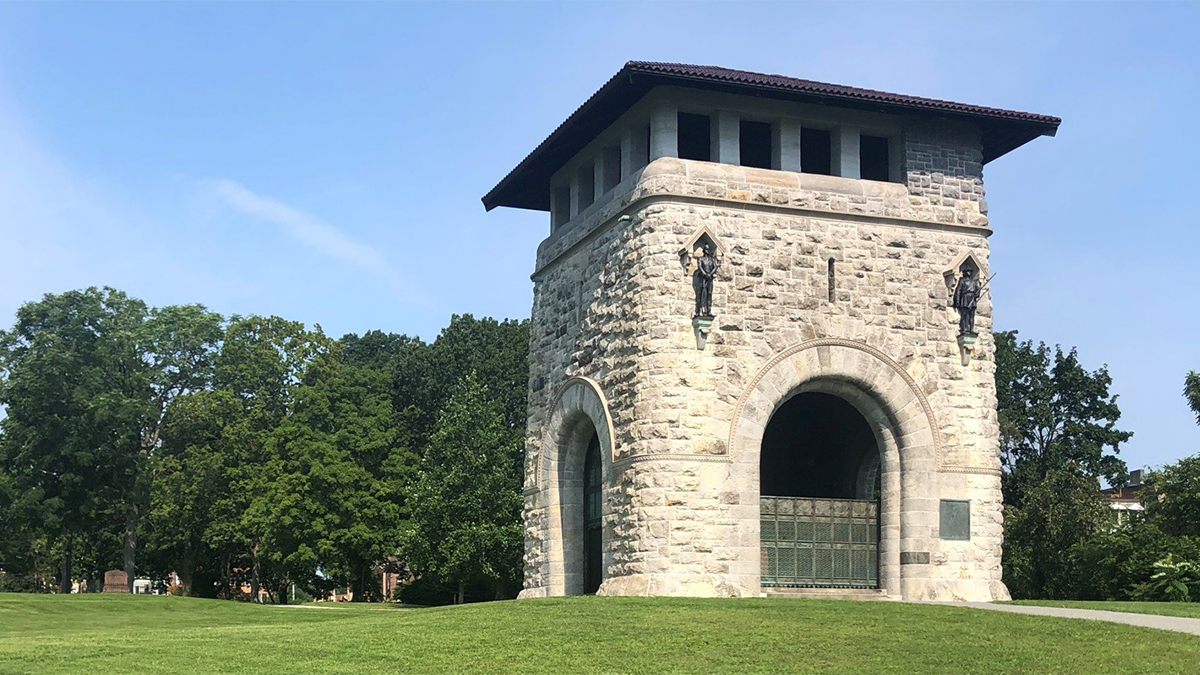
With a vegetative screen of maple and oak trees concentrated on the property’s western half; the remainder offers an open lawn with a tree- and shrub-lined perimeter, affording historically strategic views of the river. Bluestone pathways wind across the landscape, looping toward the 53-foot-tall limestone Tower of Victory (John H. Duncan, 1887) to the northeast, memorializing the American Revolution’s centennial. Near the headquarters are the grave of Uzal Knapp (1759–1856)—the last surviving member of Washington’s Life Guard Corps—and The Minuteman statue (Henry Hudson Kitson, 1924). Directly south is a brick, Federal Revival museum (Franklin B. Ware, 1910).
In 2003 the Open Space Institute purchased 1.6 acres to protect the site’s historic river views. Washington’s Headquarters was designated a National Historic Landmark (1961) and listed in the National Register of Historic Places (1966). It is a contributing feature of the East End Historic District (1985) and located within the Maurice D. Hinchey Hudson River Valley National Heritage Area (1996).