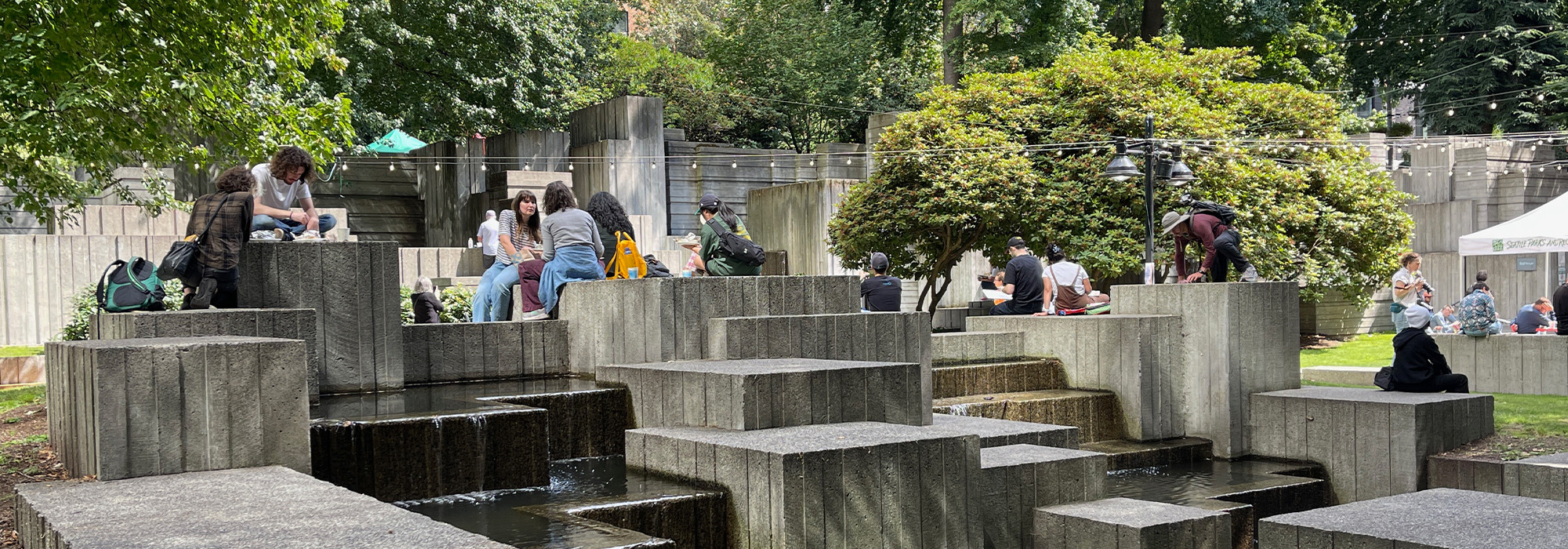
Freeway Park Turns 50 as Rehabilitation Advances
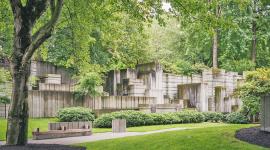
Surviving 50 years is a triumph, especially for an urban park. The nation’s bicentennial saw the opening of numerous sites throughout the country. Over the years, the initial enthusiasm and novelty for them turned into daily living and familiarity. What also became part of the routine was the need for effective maintenance and programming, the lack of which has bedeviled significant Modernist sites like Seattle’s Freeway Park, designed by landscape architect Lawrence Halprin. Fortunately, the park’s half century is marked by renewal (and not by being reduced to rubble). For the past twenty years, The Cultural Landscape Foundation (TCLF), working with an exceptional array of passionate and dedicated advocates in Seattle, has been helping foster the park’s renaissance. What follows is an accounting to that journey and a look at Freeway Park’s future.
Much has occurred since TCLF first enrolled Seattle’s Freeway Park—a masterwork by landscape architect Lawrence Halprin—in its nascent Landslide program twenty years ago. Since, TCLF has served as a consulting party in the Section 106 review process, per a programmatic agreement in 2018; supported the site’s listing in the National Register of Historic Places (2019) and designation as a City of Seattle Landmark (2022); included the site in the acclaimed traveling photographic and digital exhibition The Landscape Architecture of Lawrence Halprin (ongoing since 2016); multiple publications; a Pioneers Oral History with Halprin (2010) that includes Freeway Park; and other advocacy initiatives.
As laid out in the 2018 programmatic agreement, the City of Seattle is required to follow federal guidelines and solicit “advisory input from TCLF and other consulting parties, for any proposed project that has potential to affect Freeway Park’s character-defining features as defined in the National Register of Historic Places nomination of the park.” Nonetheless, in May 2024, TCLF learned—via a Google alert—that the city advanced proposals to rehabilitate the park without consulting them or the other affected parties.
By November 2024, the project was advancing to 90% design development stage and included plans for the construction of a bathroom/“concierge” facility and a storage facility, both of which would have an adverse effect on the park as a whole and, more specifically, on its character-defining Seneca Plaza.
As last reported by TCLF in January 2025, the project was paused following appeals to officials at the Federal Highway Administration and the Advisory Council on Historic Preservation, who were unaware that TCLF and other consulting parties had been excluded from the review process.
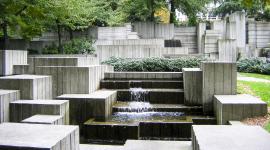
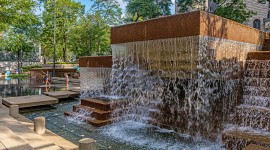
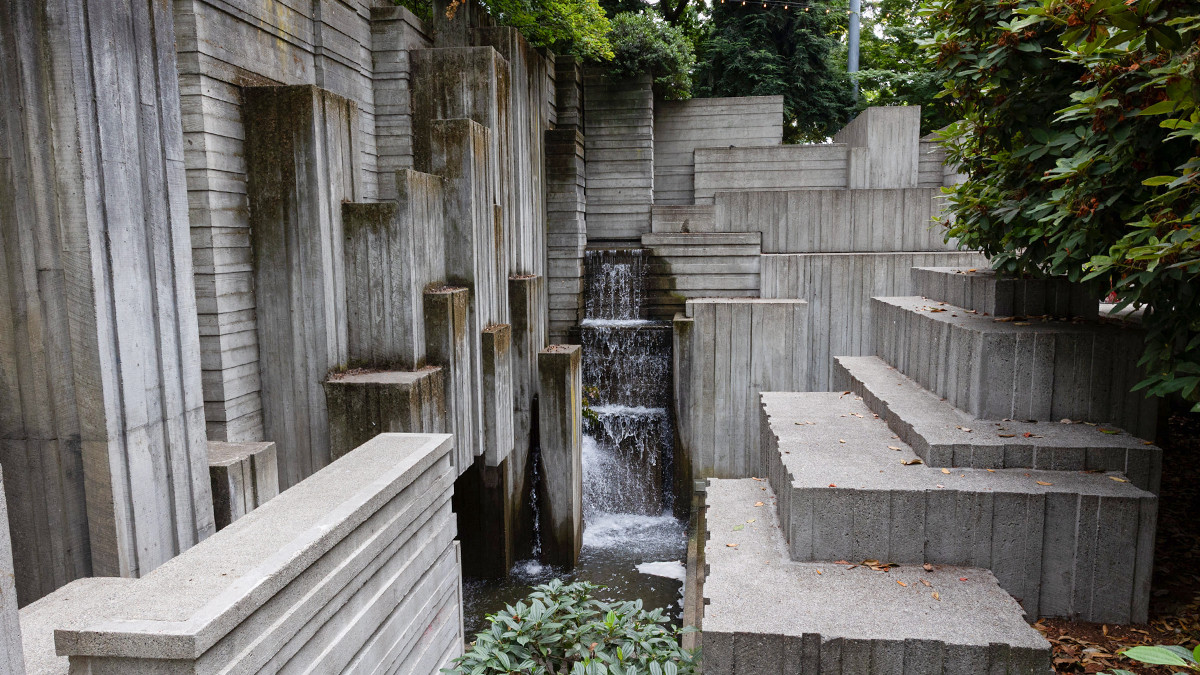
Regardless, two projects recently coalesced to rehabilitate the park's aging infrastructure. Several fountains (the American Legion, Paul Piggott, and Canyon Cascade) were rerouted from the city’s storm drains to the sanitary sewer, and the park’s pump and fountain pipes were cleaned and retrofitted. Following this work, as of May 2026, the iconic Canyon Cascade fountain was turned back on, animating the park and inviting play.
Eight years after receiving funding for the project, Seattle Parks and Recreation commenced construction on the first phase of the Freeway Park Improvement Project in March 2026. The park’s existing bathroom facilities and cedar benches were rehabilitated, while new signage and wayfinding will be installed before the end of the year. Phase Two is slated to begin in 2027, which would result in a new electrical system, new lighting at existing poles, and architectural lighting spot improvements. As of now, plans to erect a bathroom/“concierge” facility and a storage facility have been put on an indefinite hold while Seattle Parks and Recreation works “to secure additional funding.” As stated on the city’s website, these facilities “may move forward in a future phase.” In a December 13, 2024 letter to Seattle Park and Recreation TCLF registered strong opposition to the siting of the bathroom/concierge facility.
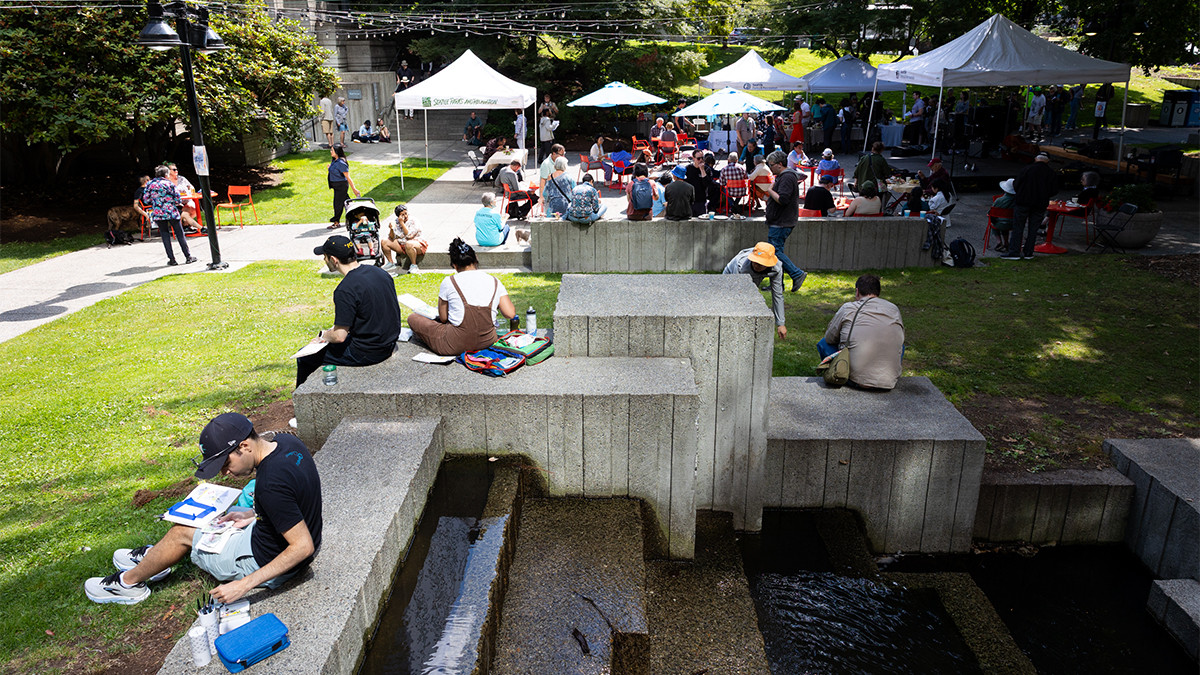
The park’s 50th anniversary celebration took place on August 22, 2026, and was organized by the Freeway Park Association (FPA)—a non-profit organization founded in 1994 to activate and advocate for Freeway Park —along with Seattle Parks & Recreation, 4Culture, Seattle Neighborhoods, and Office of Arts and Culture. In advance, FPA convinced the City to rehabilitate the park’s understory using Halprin’s approved plant palette, remove several dead trees, and clean graffiti and grime from concrete walls and pathways.
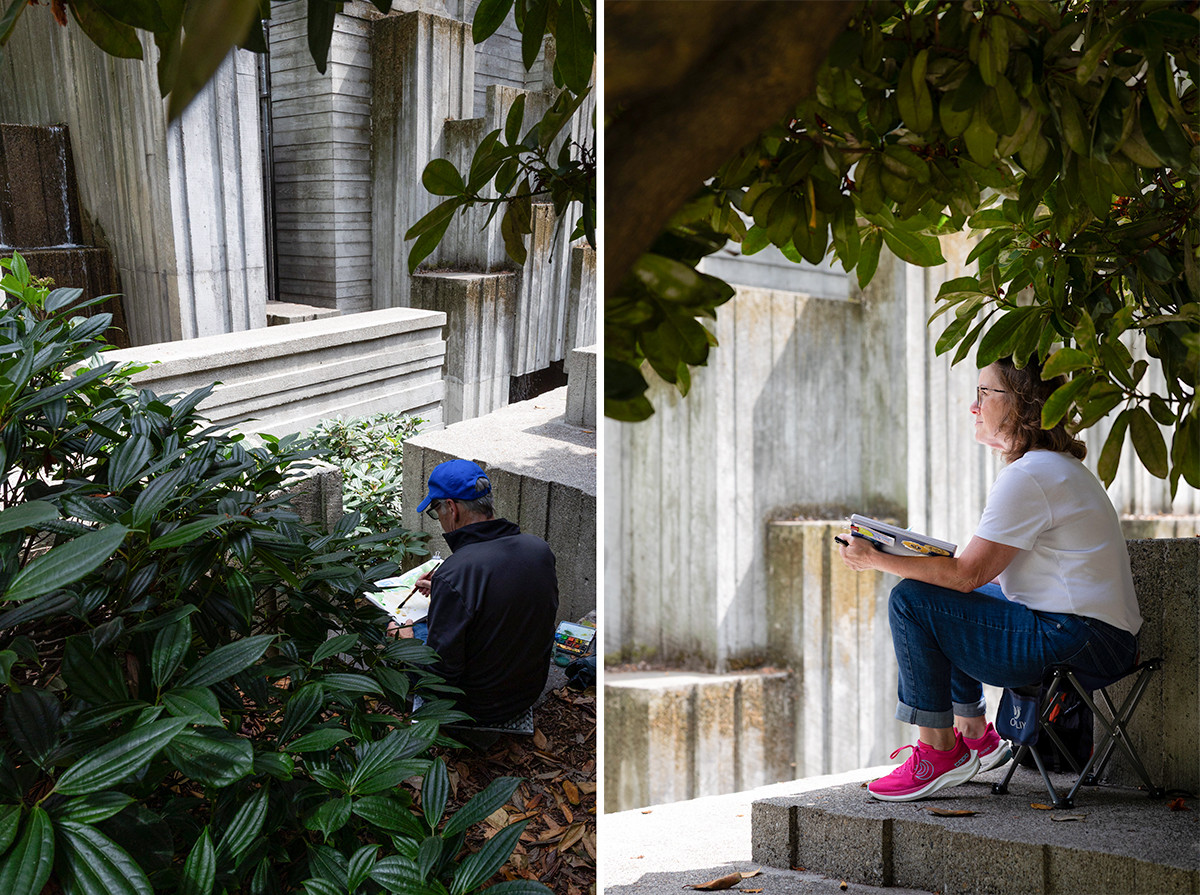
The celebration attracted more than 400 people and featured live music, art installations, and tours that revealed the park’s history and design. Community partners from Historic Seattle, Docomomo US/WEWA, and Lid I-5 shared images and stories from the park’s past 50 years, while inviting visitors to imagine what the next 50 years could look like. Riisa Conklin, FPA’s Executive Director, reflected on the event, sharing with TCLF, “It was a dream come true to see the park full of life and to have the opportunity to share the whole story of this important place with our community. Our work has been focused on the stewardship of this park as a community gathering place or a stage for arts & culture, but it is also equally important to appreciate the park as a work of art unto itself, as an oasis for contemplation, reflection and rest. With the appropriate amount of resources and care, Freeway Park can be both.”
Banner photo by Eugenia Woo, Docomomo US/WEWA