


Threats to D.C.’s Monumental Core
Editor's Note: Who knew that 2026 would be this crazy? It’s hard to keep tabs on all the administration’s attempts to redesign the nation’s capital, so here’s a quick end of summer accounting as we prepare for the next rounds of what has become a game of “whack-a-mole.” This article is long—we apologize for that—but we hope it provides some clarity and insight.
As The Cultural Landscape Foundation (TCLF) observed in the article of April 27, 2026, An Arch, a Ballroom, and Repainting the Reflecting Pool ... What Next? the processes and protocols on which advocates have relied for decades have been severely compromised. The two regulatory bodies with the most sway—the U.S. Commission of Fine Arts (CFA) and the National Capital Planning Commission (NCPC)—are completely (the former) and largely (the latter) stocked with presidential appointees with little or no relevant experience in landscape architecture, architecture, the fine arts, and urban planning. There are also reviews under the National Environmental Preservation Act (NEPA) and Section 106 of the National Historic Preservation Act (NHPA) (from which the White House ballroom project is exempt).
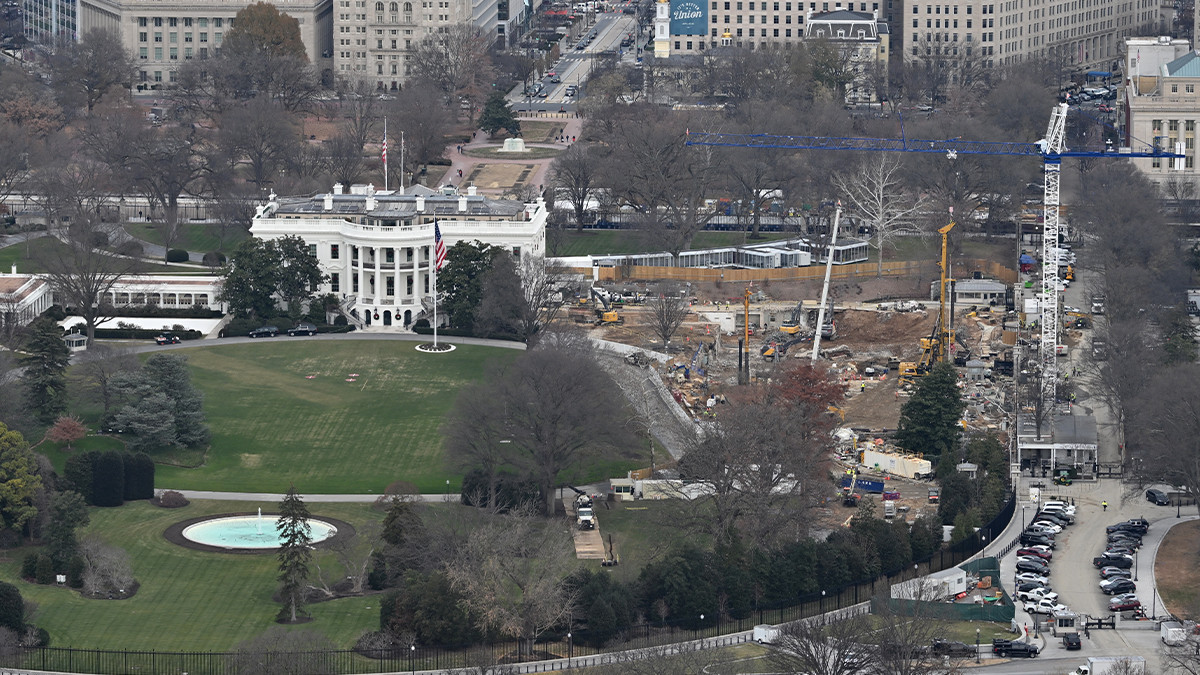
The White House ballroom. On July 31, 2025, the administration announced plans to build a ballroom and said the East Wing would not be affected. For three days, beginning on October 20, 2025, the administration shocked the nation by tearing down the East Wing to make way for a 90,000-square-foot ballroom. In December 2025, the National Trust for Historic Preservation filed suit to halt the work. The Department of Justice (DOJ) claims the project is not subject to judicial review and that only Congress has the power to authorize the project (Congress has declined to do so and the president claims Congress has no authority). Both the CFA and NCPC have given the project “concept” and “final” approval, even though each body approved different versions of the design. In a two-to-one ruling on August 7, 2026, a Court of Appeals sided with the National Trust, a decision that the DOJ appealed to the Supreme Court on August 14. The DOJ continues to claim that the National Trust and one of their members on whose behalf the suit was filed do not have “standing” to sue. Thus far, court rulings have favored the National Trust, which filed their response to the Supreme Court on August 18. At least one question remains: If the Supreme Court rules in favor of the National Trust and orders a halt to the work and Congress continues to avoid authorizing construction, will the administration ignore the court’s ruling and continue the building project?
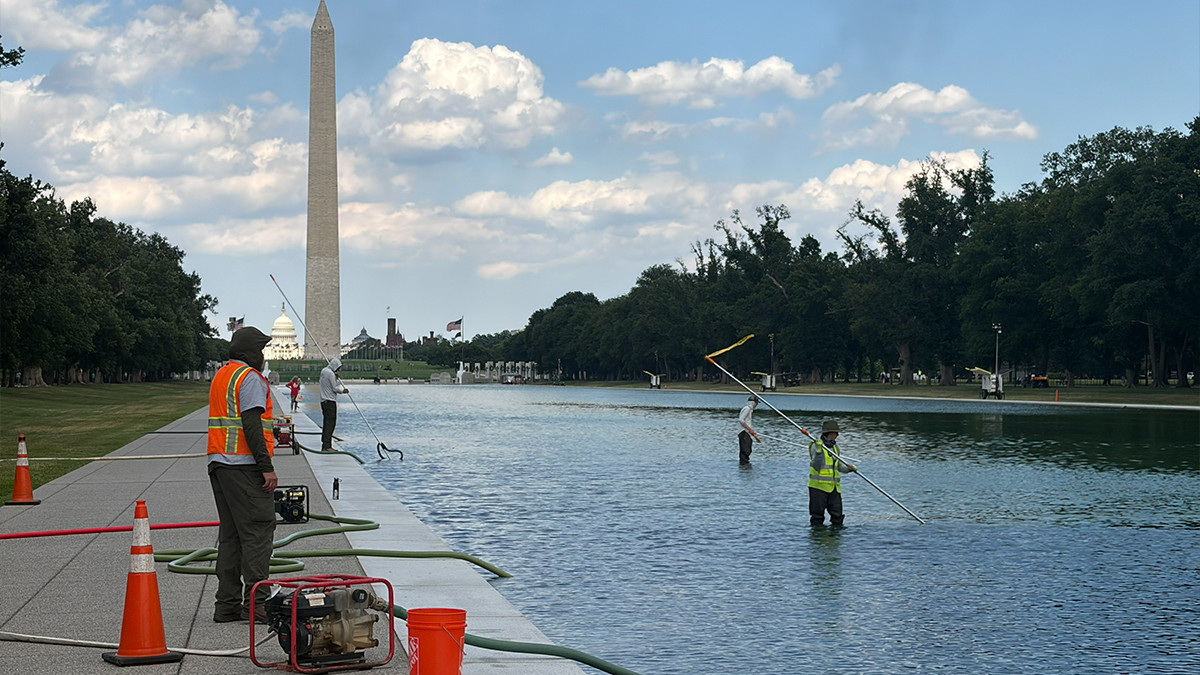
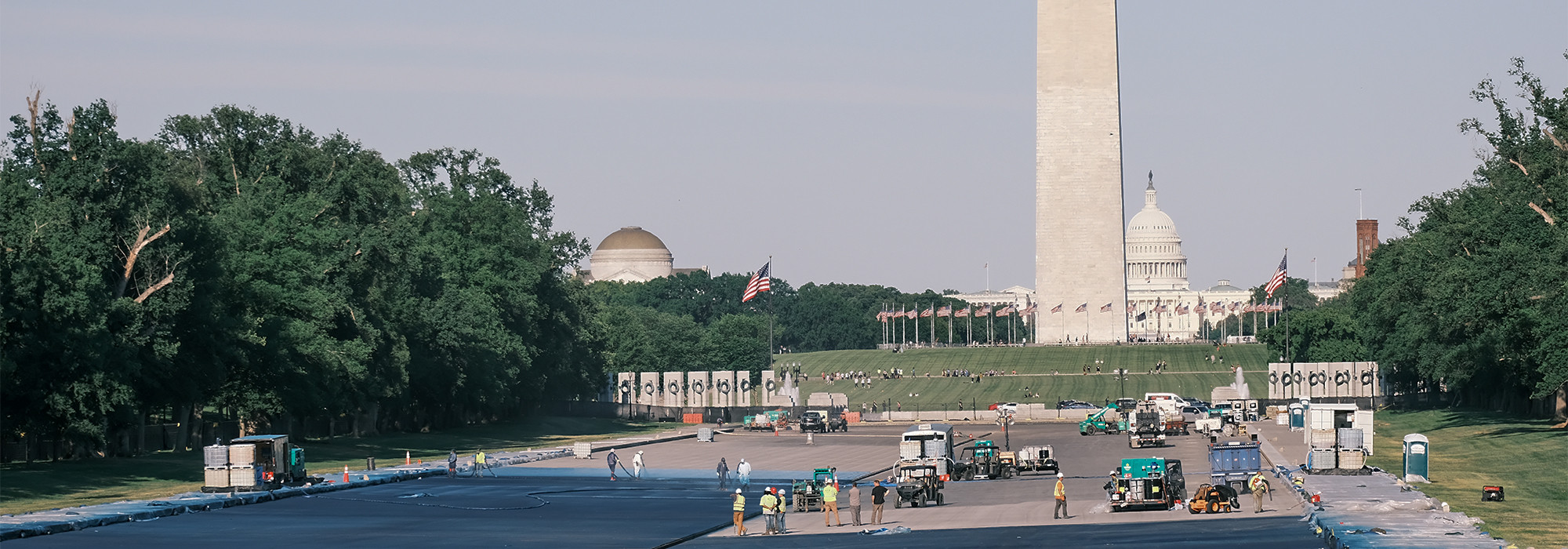
The Reflecting Pool visually connecting the Lincoln Memorial and the Washington Monument. In late April 2026, workers drained the Reflecting Pool and prepared to paint the basin “American flag blue” on orders from the president. The Cultural Landscape Foundation (TCLF) engaged the Washington Litigation Group and on May 11, 2026, filed suit to: [a] stop the work underway through a preliminary injunction (PI) and/or a temporary restraining order (TRO), and [b] insure the project was subject to a full review under Section 106 of the National Historic Preservation Act. On May 19, TCLF’s attorneys filed a brief that cited a National Park Service document that stated NPS had granted the pool painting project a “streamlined [Section 106] review” even though it was “not eligible.” The brief also quotes NPS admitting that the “streamlined review” was being done because of pressure by “White House leadership.” At a hearing on May 21, Judge Nichols declined to issue a PI/TRO and the painting project continued.
The pool painting project, as reported by media around the world, was a high-profile fiasco. The epoxy liner applied to the concrete basin began exfoliating shortly after its application and the pool was overtaken with algae. The president repeatedly claimed vandals had cut the pool liner. However, U.S. Attorney for D.C. Jeanine Pirro, in dropping charges against a D.C.-area resident accused of vandalizing the pool, said the damage was due to a “botched installation.” Nevertheless, the firm that received the no-bid contract to do the work in the first place oversees redoing it and the pool is slated to reopen on September 10, 2026.
As for the ongoing lawsuit, the DOJ claims that the plaintiffs, TCLF’s Founding President & CEO, Charles A. Birnbaum, and the foundation, do not have “standing,” the same claim made against the National Trust in the ballroom suit. The Supreme Court’s decision in the ballroom suit could affect the trajectory of TCLF’s suit.
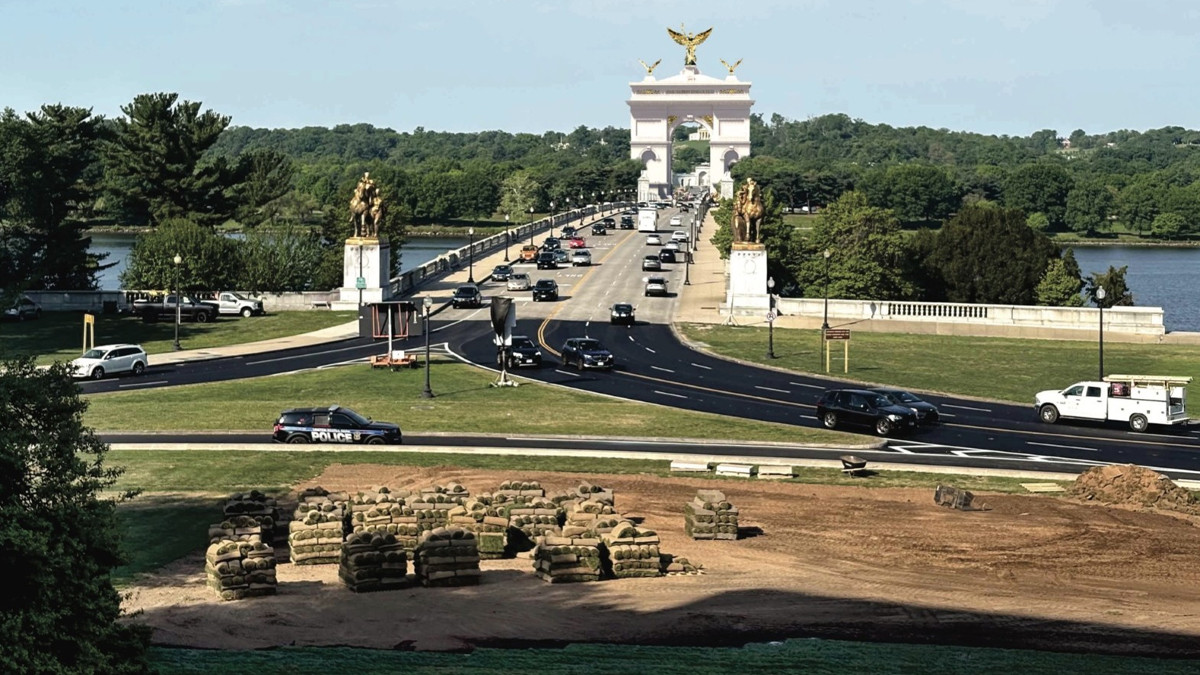
The Triumphal Arch. For more than twenty-five years, building a triumphal arch (or three) in Washington, D.C., has been a pet project of CFA Chairman Rodney Mims Cook, Jr., according to the Washington Post. With the current administration, Cook found a willing host. The currently proposed 250-foot-tall structure would be built between the Lincoln Memorial and Arlington National Cemetery, which includes Arlington House.
As TCLF wrote in "A Slap in the Face to the Lincoln Memorial," landscape architect Frederick Law Olmsted, Jr., who over the span of many decades influenced the design evolution of the Monumental Core, dismissed the idea of a triumphal arch in 1916, observing that the arch would permanently block the important (and now historically significant) views between Arlington House—the former home of Confederate General Robert E. Lee—across Arlington Bridge to the Lincoln Memorial, which symbolically reunited the nation after the Civil War. The arch would also permanently alter views from the Eternal Flame and gravesite of President John F. Kennedy to the Lincoln Memorial. Instead, those attending funeral services at Arlington Cemetery along with other visitors to this solemn site would see tourists frolicking on the roof deck of the arch.
Among the many shocking aspects of this project is that: [a] there was no design competition for what would be the second largest memorial in the Monumental Core after the Washington Monument, and [b] the federally mandated reviews under Section 106 of the National Historic Preservation Act, which should have commenced at the project’s earliest stages, were initiated after it was approved by the CFA. Among others, the Section 106 review would have helped determine whether the site chosen for the arch or its proposed scale were appropriate.
There has been only one Section 106 consulting party meeting to date, and it was only after that meeting took place that TCLF and six other organizations who were currently in litigation with the administration were invited to participate. The CFA gave final design approval to the project on May 21, 2026 (without seeing final designs), and the project was expected to be reviewed by NCPC on September 3 (the project must complete the Section 106 review to get final approval from NCPC). However, the draft agenda for the September 3 meeting, unveiled on Friday, August 14, did not include the arch.
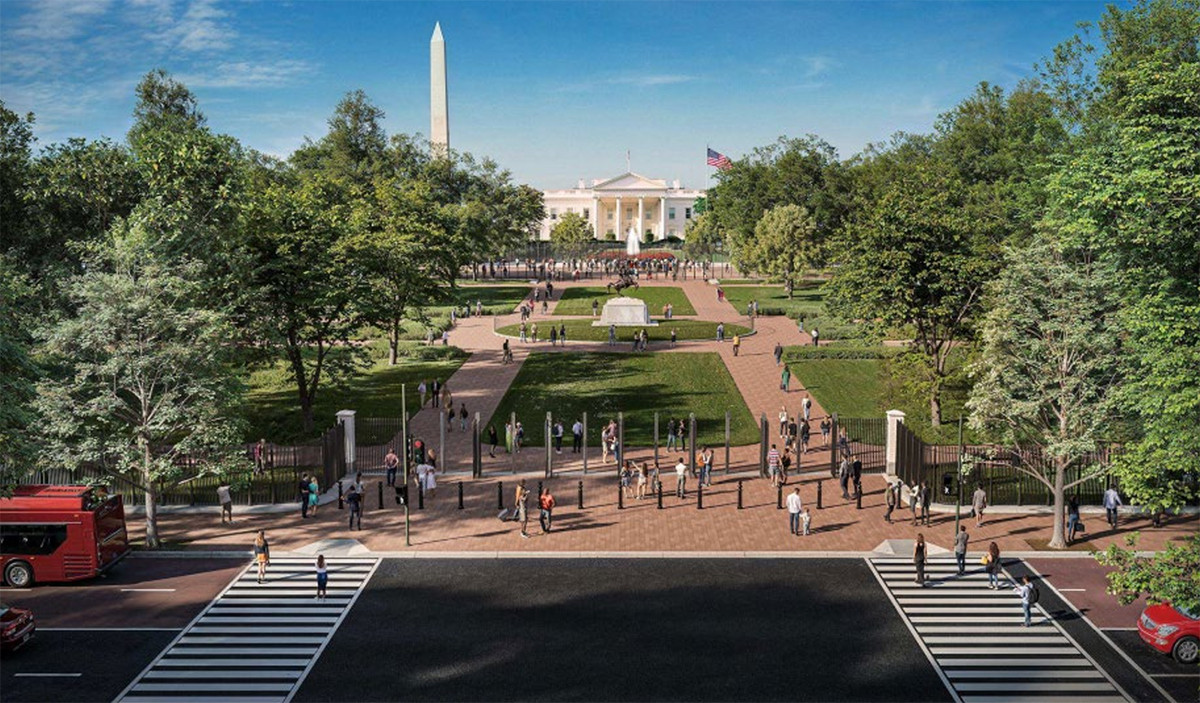
Lafayette Park across the street from the White House. This eight-acre site and National Historic Landmark (NHL) is ground zero for First Amendment rights and there’s a proposal to permanently enclose it with a ten-foot-tall metal fence. Lafayette Park has seen public gatherings and protests starting with the Suffragette movement and up to Black Lives Matter (in fact, the three-block section of 16th Street, immediately north of the park, was once Black Lives Matter Plaza). The park is currently ringed by an unsightly temporary metal fencing buttressed with Jersey barriers.
The first Section 106 consulting party meeting was held on August 12, 2026, during which representatives from the U.S. Secret Service and the multi-national consulting firm, AECOM, presented a variety of fencing options. TCLF’s Charles Birnbaum noted early in the presentation that the information underlying the design decisions were relying solely on a 1970 NHL district designation. While the designation was revisited in 2022 (the amendment was prepared by the National Park Service) with substantially more information about the landscape’s significance, that update had not been forwarded to the National Register of Historic Places for inclusion into NPS’s official record and was not considered during the fence design process. Birnbaum directly addressed Secret Service representative Andrew Stohs (starting at 35:58) and ultimately asked: “How can we possibly get into a fence design and adverse effects if we don’t know what the period of significance and what the areas of significance are? Is this the cart before the horse?” Later in the meeting both David Maloney at the D.C. State Historic Preservation Office and Sarah Batcheler, Assistant Secretary at the CFA, buttressed Birnbaum’s suggestions stating that NPS should update documentation to provide an up-to-date and more thorough assessment of the park’s historic themes and significance. The project is scheduled for NCPC review on September 3, though the presentation submitted to the commission still uses the out-of-date data. TCLF sent a letter to NPS on August 17 specifically asking when the documentation would be updated.
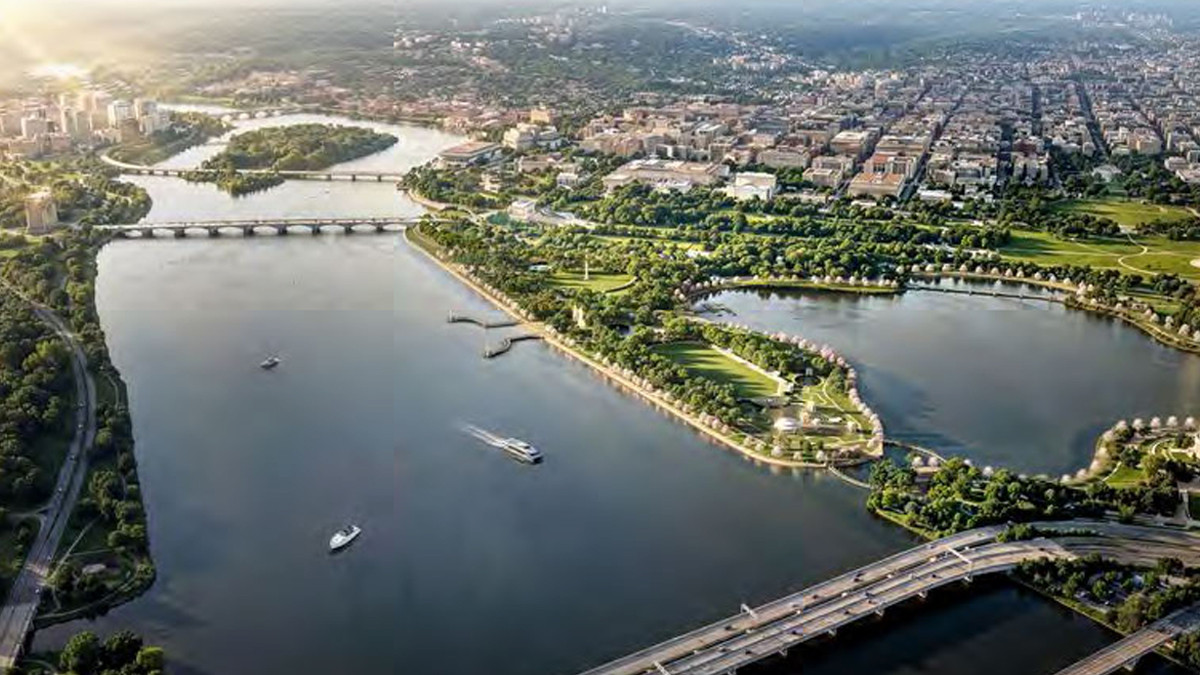
The National Garden of American Heroes at West Potomac Park, which is part of the National Mall. West Potomac Park has been listed in the National Register of Historic Places as part of the East and West Potomac Parks Historic District since 1973. It sits on the National Mall and is home to some of the capital’s most prominent landmarks, including the Korean War Veterans Memorial, the Franklin Delano Roosevelt Memorial, and the Martin Luther King, Jr. Memorial. Nestled alongside these monuments and the Potomac River, the park’s open fields provide a scenic landscape for recreation and reflection. The president has characterized the park as “a totally BARREN field of Prime Waterfront Real Estate.” According to the President, his administration has committed to “transforming” the park into a massive sculpture garden as part of the upcoming 250th anniversary celebrations. The so-called “National Garden of American Heroes” would feature 250 statues—each at least eight feet tall—set among formal gardens, reflecting pools, plazas, dining facilities, and an amphitheater, all of which would displace the park’s existing open spaces and recreational fields.
On June 15, 2026, TCLF and six other plaintiffs sued the National Park Service to prevent the project. As the suit states:
The West Potomac Plan is unlawful. Congress has made clear that the National Mall is a “substantially completed work of civic art”—not a personal sandbox for each President to renovate however he likes. To that end, Congress has decreed that no new “commemorative work” shall be located within “the great cross-axis of the Mall,” an area that includes West Potomac Park.
In defiance of that plain congressional command, Defendants have adopted and begun implementing the West Potomac Plan. In doing so, Defendants have failed to comply with several statutes governing a project of this magnitude, including the Commemorative Works Act (CWA); 40 U.S.C. § 8106; the National Historic Preservation Act (NHPA); the National Environmental Policy Act (NEPA); the National Park Service Organic Act of 1916; and the Act of March 3, 1897, that established the park.
No court date has been set, and the project is not currently scheduled to be reviewed by the CFA or NCPC; moreover, no Section 106 review has been initiated. On August 17, 2026, the Department of Justice filed a motion to dismiss the lawsuit. On page one of the Introduction, they note that "Trump's 'vision' for the Garden ... is still a preliminary concept."
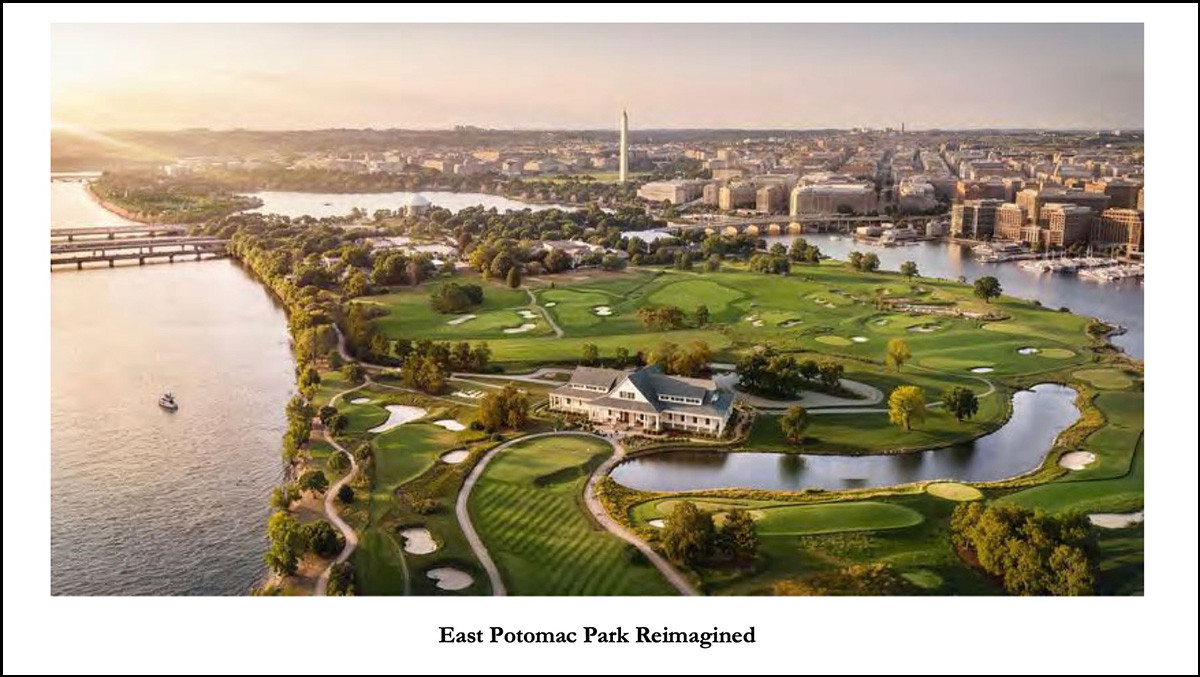
The high-end golf course at East Potomac Park. The park is a 327-acre man-made island reclaimed from the Potomac River Flats by the U.S. Army Corps of Engineers. In 1897 Congress officially designated the land as a public park decreeing it be "forever held and used as a park for the recreation and pleasure of the people." A major feature of the attenuated wedge-shaped flat landscape is the 210-acre East Potomac Golf Course, a municipal course that opened in 1919. In October 2020, the National Links Trust signed a 50-year agreement with the National Park Service (NPS) to operate and renovate the course (along with two other courses on federal land in the D.C. area). In December 2025, NPS terminated the agreement, claiming the trust was in default. The site is threatened with a wholesale redesign. President Donald Trump has said that he wants the municipal course to be renovated into a “world-class, U.S. Open-caliber course.” On February 13, 2026, the D.C. Preservation League and two area golfers filed suit against the Department of the Interior, citing violations of environmental and historic preservation regulations and illegal dumping. The plaintiffs are represented by Democracy Forward and Lowell & Associates, with support from Norm Eisen and the Democracy Defenders Fund. The first Section 106 consulting party meeting, scheduled for Thursday, August 20, 2026 (and rescheduled from the week prior), was cancelled on Monday morning August 17. No reason was given and no other details were provided.
That's where things stands right now ... and it will all change.
Related Content
White House Grounds
Washington, DC
Lincoln Memorial Grounds
Washington, DC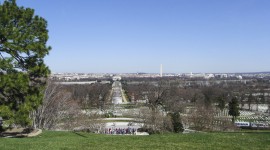
Arlington National Cemetery
Arlington, VA
Lafayette Park - D.C.
Washington, DC